-
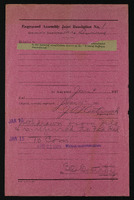 Original bill file for Assembly Joint Resolution No. 1
 In addition to granting women the right to vote, the 1911 women’s suffrage amendment also paved the way for women to hold political office in California. In 1918, Esto B. Broughton, Elizabeth Hughes, Anna L. Saylor, and Grace S. Dorris became the first four women elected to the California State Assembly.
Though fifteen states had already granted women full voting rights, a federal amendment was required to secure nationwide suffrage. To push for this national change, two almost identical resolutions were introduced on January 9, 1919 to urge the U.S. Congress to move forward with “the amendment to the National Constitution known as ‘The Federal Suffrage Amendment.’". On just her third day in office, newly elected Assemblywoman Grace S. Dorris introduced Assembly Joint Resolution No. 1. Simultaneously, Senate Joint Resolution No. 3 was introduced by Senator Burnett, a male colleague in the State Senate. While Dorris's historic Assembly bill ultimately died in committee, its twin Senate resolution successfully advanced, passing both chambers on January 17, 1919.
-
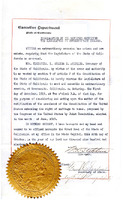 Proclamation by the Governor for the 19th Amendment
 The 19th Amendment to the U.S. Constitution was passed by the U.S. House of Representatives on May 21, 1919 and the U.S. Senate on June 4, 1919 in a special congressional session. The amendment was then sent to the states for ratification.
On October 25, 1919, Governor William D. Stephens issued a proclamation calling the California Legislature into a special session to consider ratification. When lawmakers convened on November 1, 1919, California ratified the amendment, becoming the 18th state to do so. The 19th Amendment received the required approval of 36 states on August 18, 1920, establishing that voting rights could not be denied on account of sex nationwide.
Finally, on August 26, 1920, the 19th Amendment was added to the U.S. Constitution, granting women in the United States the right to vote on the federal level. This day is still commemorated and known today as Women’s Equality Day.
-
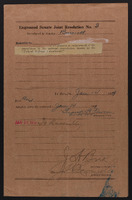 Original bill file for Senate Joint Resolution No. 3
 In addition to granting women the right to vote, the 1911 women’s suffrage amendment also paved the way for women to hold political office in California. In 1918, Esto B. Broughton, Elizabeth Hughes, Anna L. Saylor, and Grace S. Dorris became the first four women elected to the California State Assembly.
Though fifteen states had already granted women full voting rights, a federal amendment was required to secure nationwide suffrage. To push for this national change, two almost identical resolutions were introduced on January 9, 1919 to urge the U.S. Congress to move forward with “the amendment to the National Constitution known as ‘The Federal Suffrage Amendment.’". On just her third day in office, newly elected Assemblywoman Grace S. Dorris introduced Assembly Joint Resolution No. 1. Simultaneously, Senate Joint Resolution No. 3 was introduced by Senator Burnett, a male colleague in the State Senate. While Dorris's historic Assembly bill ultimately died in committee, its twin Senate resolution successfully advanced, passing both chambers on January 17, 1919.
-
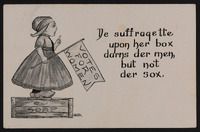 "De suffragette" postcard
 Those opposing women's suffrage created their own ephemera to spread their message, like this postcard from 1913 depicting a woman standing on a soap box declaring, “De suffragette upon her box darns der men, but not der sox.” This postcard evidenced that although women may have won the vote in California, there were still strong anti-suffragette sentiments circulating in the United States in the years following 1911.
-
 Information ribbon with golden bear and "Votes for Women" pin attached
 In the years following the passage of the 1911 state suffrage amendment, supporters continued to advocate for the federal enfranchisement of women across the country. Suffragists created and distributed ephemera to publicize their cause and gain support for the movement, including literature, pennants, posters, shopping bags, playing cards, postcards, and pin-back buttons, such as this ribbon with a “Votes for Women” pin from 1912.
-
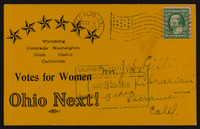 National American Woman Suffrage Association "Votes for Women, Ohio Next" postcard from suffragist Alice Park to California State Librarian James L. Gillis
 This postcard from our ephemera collection, sent by California suffragist Alice Locke Park to State Librarian James L. Gillis on May 9, 1912, features 6 stars, representing the only states that had granted women full suffrage by 1912: Wyoming (1869), Colorado (1893), Utah (1896), Idaho (1896), Washington (1910), and California (1911).
Printed by the National American Woman Suffrage Association, the postcard reflects the desire to keep momentum going after California’s 1911 win by shifting the focus to Ohio's state suffrage amendment, which was ultimately defeated by male voters in both 1912 and 1914. Women in Ohio, along with millions of others nationwide, had to wait until the federal ratification of the 19th Amendment to finally gain the right to vote.
-
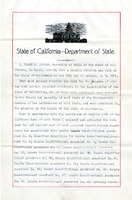 Special Election Certification by California Secretary of State Frank C. Jordan
 This official certification, issued by California Secretary of State Frank C. Jordan, records the results of the October 10, 1911 special election and formally certifies the constitutional amendments approved by California voters. Among the measures adopted was Senate Constitutional Amendment No. 8 (Proposition 4), which amended the California Constitution to grant women the right to vote, as well as several other Progressive Era reforms approved during the same election, including measures expanding direct democracy and government reform.
Senate Constitutional Amendment No. 8 passed by a margin of just 3,587 votes, with a final count of 125,037 to 121,450. Its passage made California the sixth state in the nation to enfranchise women, nearly nine years before the ratification of the 19th Amendment to the U.S. Constitution. Following the amendment’s adoption, Governor Johnson called a special legislative session in November 1911 to revise state election laws and fully implement women’s newly won voting rights.
-
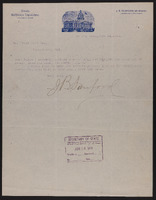 Letter from Senator J.B. Sanford to Secretary of State Frank C. Jordan with enclosed argument against Senate Constitutional Amendment No. 8
 J. B. Sanford was a California State Senator representing the 4th Senate District and served as Chairman of the Democratic Caucus during the 1911 legislative session. He was one of the most prominent legislative opponents of women's suffrage in California. Sanford authored the official ballot argument against Senate Constitutional Amendment No. 8 (Proposition 4).
In it, Sanford argues that women should not be granted the right to vote because suffrage is a privilege rather than an inherent right. He asserts that political involvement would distract women from their primary domestic duties, disrupt traditional gender roles, and ultimately harm the family structure. Furthermore, he claims that men already adequately protected women's interests in government and that granting women the vote would lead to increased social instability.
-
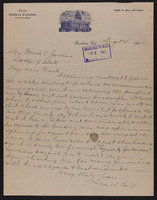 Letter from Senator Charles W. Bell to Secretary of State Frank C. Jordan with enclosed argument for Senate Constitutional Amendment No. 8
 Charles W. Bell’s argument for Senate Constitutional Amendment No. 8 was the official argument in favor of the women's suffrage amendment that appeared in California's voter information pamphlet before the October 10, 1911 special election. Its purpose was to persuade California's male voters to approve Proposition 4, which would amend the California Constitution to grant women the right to vote.
Senator Charles W. Bell was an ardent supporter of women’s suffrage who had spent years campaigning for the cause. In the 15-page argument, Bell explains that women deserve the right to vote because they are educated, civic-minded citizens whose participation will strengthen government. He urges voters to approve the amendment, asserting that equal suffrage would make California's democracy more representative and effective.
-
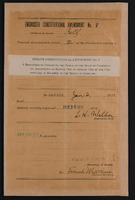 Original bill file for Senate Constitutional Amendment No. 8
 Absent of terms such as “women” or “sex”, the language for Senate Constitutional Amendment No. 8 appears intentionally neutral, labeled as “A Resolution to Propose to the People of the State of California an Amendment to Section One of Article Two of the Constitution in Relation to the Rights of Suffrage.”
However, feelings about the amendment were decidedly strong. The arguments for and against Senate Constitutional Amendment No. 8 were closely watched by suffrage organizations, with crowds of onlookers filling the gallery and the lobby of the Capitol. Authored by Republican State Senator Charles W. Bell from Pasadena, Senate Constitutional Amendment No. 8 was passed by the Senate on February 2, 1911, receiving 66 ayes and 12 noes.
Senate Constitutional Amendment No. 8 would be introduced to the public as Proposition 4 on the ballot for the special election scheduled for October 10, 1911, along with a variety of other reform amendments passed by the Senate.
-
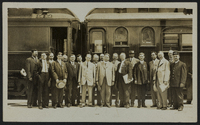 Governor Hiram Johnson with the California Delegation to the 1912 Progressive National Convention
The Progressive Movement transformed California politics in the early twentieth century by promoting government reform, greater public participation, and limits on the influence of powerful corporations and political machines. Women’s suffrage became part of this broader reform agenda.
Governor Hiram Johnson (1866–1945) served as California’s 23rd governor from 1911 to 1917 and was a leading figure in the Progressive Movement. Johnson became tied to the suffrage cause through the 1910 California Republican platform, which endorsed women’s right to vote as part of a larger slate of progressive reforms. Motivated by Johnson’s promise to support their political rights, women in California quickly mobilized for him in his bid for governor, organizing grassroots efforts in support of his campaign in multiple counties. As the new governor, he insisted that the Legislature honor his pledge by submitting a women’s suffrage amendment before the Senate on January 6, 1911, only 3 days after he took office.
-
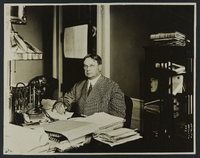 Governor Hiram W. Johnson, 1911-1917, at work in Governor's Office
 The Progressive Movement transformed California politics in the early twentieth century by promoting government reform, greater public participation, and limits on the influence of powerful corporations and political machines. Women’s suffrage became part of this broader reform agenda.
Governor Hiram Johnson (1866–1945) served as California’s 23rd governor from 1911 to 1917 and was a leading figure in the Progressive Movement. Johnson became tied to the suffrage cause through the 1910 California Republican platform, which endorsed women’s right to vote as part of a larger slate of progressive reforms. Motivated by Johnson’s promise to support their political rights, women in California quickly mobilized for him in his bid for governor, organizing grassroots efforts in support of his campaign in multiple counties. As the new governor, he insisted that the Legislature honor his pledge by submitting a women’s suffrage amendment before the Senate on January 6, 1911, only 3 days after he took office.
-
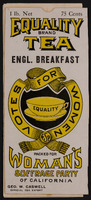 Equality Brand Tea trademark
 The trademark is one of many from the Trademark Series within the Secretary of State’s Records at the California State Archives. California created the nation’s first trademark law in 1861. According to the law, companies had to apply to trademark their brands through the California Secretary of State’s Office.
This trademark for “Equality Brand Tea” depicts a drawing of a ribbon with “Votes for Women” emblazoned on it, surrounding a teacup labeled “Equality.” Packed for the Woman’s Suffrage Party of California, the trademark was a marketing tactic used by the organization to promote and raise money for their cause.
George W. Caswell, the tea’s distributor and a well-known coffee and tea merchant in San Francisco, officially filed the trademark on June 22, 1911. However, in keeping with the practice of actively using trademarks in commerce prior to filing, Caswell began distributing the tea in support of the Women’s Suffrage Party beginning in 1910. The proceeds from the sale of Caswell’s tea provided crucial funding during the 1911 campaign for women’s suffrage in California.
-
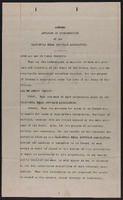 Articles of Incorporation of the California Equal Suffrage Association
 The California Equal Suffrage Association was founded in 1870 and incorporated as a state-registered organization in 1904.
When the organization was founded, it was originally named the California Woman Suffrage Association. In 1896, the organization rebranded as the California Equal Suffrage Association. The name change was an effort to use more inclusive language in the hopes that it would encourage men to join the organization. The group rallied for women’s suffrage by distributing literature and through events they held. The endurance of the California Equal Suffrage Association demonstrates that many Californians remained deeply committed to women’s political rights decades before legal enfranchisement.
-
 Petition to 1878-1879 Constitutional Convention for women’s suffrage
 Ahead of the second California Constitutional Convention held in Sacramento from September 28, 1878 to March 3, 1879, petitions were circulated around California in support of amending Article II of the 1849 constitution. The petitions included over 2,500 signatures and asserted that “no citizen of the State shall be disenfranchised on the account of sex.” The petition shown here from October 10, 1878 contains hundreds of signatures and measures over seven feet long.
However, the many signatures indicating support for the amendment were not enough to sway the all-male delegation at the 1878-1879 Constitutional Convention. Several delegates expressed fears about the impact of enfranchising women as well as concerns that the inclusion of women’s suffrage in the new 1879 constitution would threaten its ratification. After several days of debate, the amendment did not move forward.
-
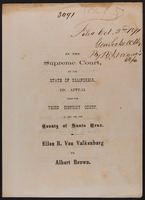 Case No. 3091, Ellen R. Van Valkenburg v. Albert Brown, Brief of Respondent
 A Brief of Respondent is filed in the appellate court by the party who won in the previous trial and defends the lower court’s original decision. Ellen Van Valkenburg began an important legal battle for women’s enfranchisement in California on July 21, 1871, when she requested that Santa Cruz County Clerk Albert Brown enter her name in the Great Register of voters. After Brown (a willing accomplice in helping her bring the case to court) refused to register her, Van Valkenburg and her lawyer, Santa Cruz Judge Albert Hagan, began legal proceedings by requesting a writ of mandamus, a judicial remedy used to compel agencies to perform ministerial acts, such as registering voters.
Van Valkenburg and Hagan argued her case by citing the 14th Amendment of the U.S. Constitution. The new amendment, ratified 3 years earlier in 1868, defined all persons born or naturalized in the U.S. as citizens protected by civil rights. Van Valkenburg and Hagan asserted that American women were considered citizens under this amendment, and that citizenship automatically granted absolute rights, including the right to vote. The case first went to California’s Third District Court. Many of America’s most prominent suffragists, including Elizabeth Cady Stanton and Susan B. Anthony, were with Van Valkenburg in Santa Cruz when the lower court ruled against her on August 16, 1871. Van Valkenburg and Hagan swiftly appealed this decision through the Supreme Court of California.
In the end, the Supreme Court of California upheld the lower court’s verdict under the reasoning that as a white American woman, Van Valkenburg already had citizenship and civil rights prior to the passage of the 14th amendment, and that the 14th amendment did not provide her with any additional political rights, such as the right to vote. While Van Valkenburg lost her case, and subsequent lawsuits failed to secure women's suffrage nationwide, the case stands as a critical early example of legal advocacy for women's political rights in California.
-
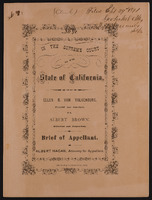 Case No. 3091, Ellen R. Van Valkenburg v. Albert Brown, Brief of Appellant
 A Brief of Appellant is filed in the appellate court by the party who lost in the previous trial and argues in favor of appealing a lower court’s decision. Ellen Van Valkenburg began an important legal battle for women’s enfranchisement in California on July 21, 1871, when she requested that Santa Cruz County Clerk Albert Brown enter her name in the Great Register of voters. After Brown (a willing accomplice in helping her bring the case to court) refused to register her, Van Valkenburg and her lawyer, Santa Cruz Judge Albert Hagan, began legal proceedings by requesting a writ of mandamus, a judicial remedy used to compel agencies to perform ministerial acts, such as registering voters.
Van Valkenburg and Hagan argued her case by citing the 14th Amendment of the U.S. Constitution. The new amendment, ratified 3 years earlier in 1868, defined all persons born or naturalized in the U.S. as citizens protected by civil rights. Van Valkenburg and Hagan asserted that American women were considered citizens under this amendment, and that citizenship automatically granted absolute rights, including the right to vote. The case first went to California’s Third District Court. Many of America’s most prominent suffragists, including Elizabeth Cady Stanton and Susan B. Anthony, were with Van Valkenburg in Santa Cruz when the lower court ruled against her on August 16, 1871. Van Valkenburg and Hagan swiftly appealed this decision through the Supreme Court of California.
In the end, the Supreme Court of California upheld the lower court’s verdict under the reasoning that as a white American woman, Van Valkenburg already had citizenship and civil rights prior to the passage of the 14th amendment, and that the 14th amendment did not provide her with any additional political rights, such as the right to vote. While Van Valkenburg lost her case, and subsequent lawsuits failed to secure women's suffrage nationwide, the case stands as a critical early example of legal advocacy for women's political rights in California.
-
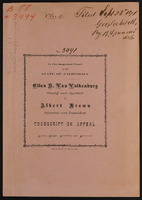 Case No. 3091, Ellen R. Van Valkenburg v. Albert Brown, Transcript on Appeal
 A Transcript of Appeal is the official written record of a trial, used by a higher court to review the lower court's proceedings. Ellen Van Valkenburg began an important legal battle for women’s enfranchisement in California on July 21, 1871, when she requested that Santa Cruz County Clerk Albert Brown enter her name in the Great Register of voters. After Brown (a willing accomplice in helping her bring the case to court) refused to register her, Van Valkenburg and her lawyer, Santa Cruz Judge Albert Hagan, began legal proceedings by requesting a writ of mandamus, a judicial remedy used to compel agencies to perform ministerial acts, such as registering voters.
Van Valkenburg and Hagan argued her case by citing the 14th Amendment of the U.S. Constitution. The new amendment, ratified 3 years earlier in 1868, defined all persons born or naturalized in the U.S. as citizens protected by civil rights. Van Valkenburg and Hagan asserted that American women were considered citizens under this amendment, and that citizenship automatically granted absolute rights, including the right to vote. The case first went to California’s Third District Court. Many of America’s most prominent suffragists, including Elizabeth Cady Stanton and Susan B. Anthony, were with Van Valkenburg in Santa Cruz when the lower court ruled against her on August 16, 1871. Van Valkenburg and Hagan swiftly appealed this decision through the Supreme Court of California.
In the end, the Supreme Court of California upheld the lower court’s verdict under the reasoning that as a white American woman, Van Valkenburg already had citizenship and civil rights prior to the passage of the 14th amendment, and that the 14th amendment did not provide her with any additional political rights, such as the right to vote. While Van Valkenburg lost her case, and subsequent lawsuits failed to secure women's suffrage nationwide, the case stands as a critical early example of legal advocacy for women's political rights in California.
-
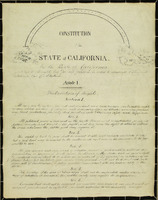 California Constitution of 1849
 California’s first Constitutional Convention was held in Monterey in 1849. The original constitution, published in both English and Spanish the same year, was written by 48 delegates on nineteen pages of parchment. Article II, The Right to Suffrage stipulates that only white males have the right to suffrage.
-
 A Revolution Remembered: Inside California’s Bicentennial Commission Records by the California State Archives, a division of the California Secretary of State's Office
-
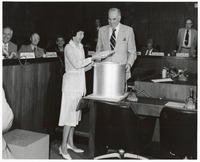 Time Capsule Ceremony
-
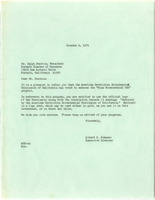 Miss Bicentennial Beauty Pageant Correspondence
-
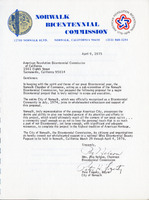 Norwalk Bicentennial Commission Correspondence
-
 Powder Puff Derby Winners
-
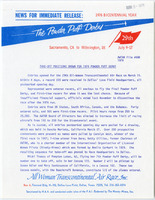 Powder Puff Derby Press Release
-
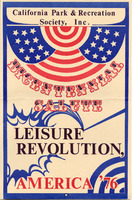 Leisure Revolution Publication
-
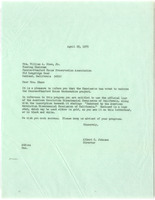 Camron-Stanford House Preservation Association Correspondence
-
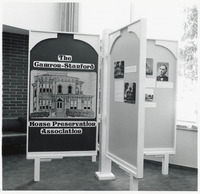 Camron-Stanford House
-
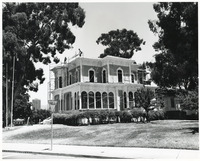 Camron-Stanford House in Oakland
-
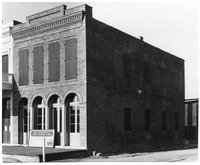 Dingley Spice Building in Old Sacramento
-
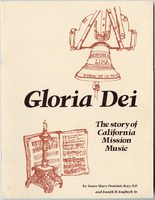 California Mission Music
-
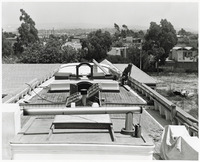 Deck of the Pilgrim Clipper Ship
-
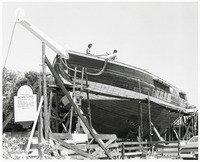 The Pilgrim Clipper Ship
-
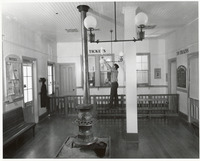 Central Pacific Railroad Passenger Station
-
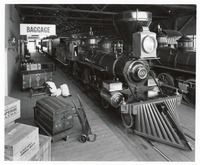 Railroad Car Restoration Project
-
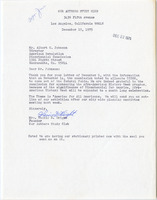 Our Authors Study Club Correspondence
-
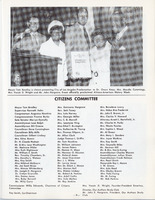 Los Angeles Mayor Tom Bradley honors the Our Authors Study Club
-
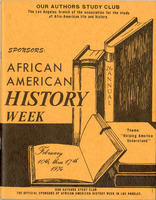 African American History Week Program
-
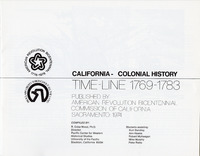 California-Colonial History Timeline
-
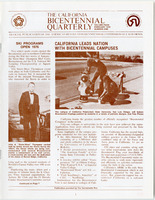 Quarterly Newsletter
-
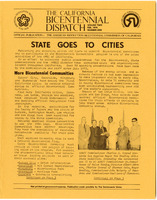 Dispatch Newsletter
-
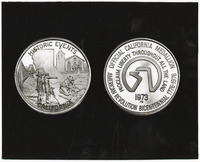 Lincoln Mint California Bicentennial Medallions
-
 American Revolution Bicentennial Logo
-
 American Revolution Bicentennial Commission of California Address
-
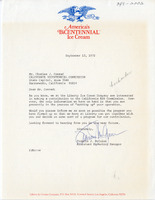 Liberty Ice Cream Company Correspondence
-
 Breaking Barriers: Women Shaping California Banner
-
 Ellen Ochoa, STS-56 mission specialist, takes a brief time out from a busy day in space to play a 15-minute set of flute music on the space shuttle Discovery’s aft flight deck
-
 Judge Abby Abinanti; Yurok Tribe
-
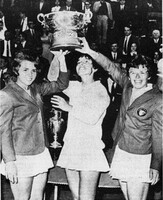 Photograph from left to right: the United States national tennis team members Carole Caldwell Graebner, Julie Heldman, and Billie Jean King in Turin, Italy, holding the Federations Cup trophy
-
 Photograph of Sylvia Mendez at a podium