-
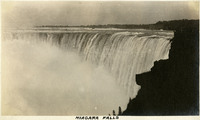 McCarthy Album 09, Photograph 122
 Caption: "Niagara Falls," c. 1925. View of Horseshoe Falls, the largest of the three waterfalls that make up the iconic Niagara Falls straddling the border between Ontario, Canada, and the State of New York.
-
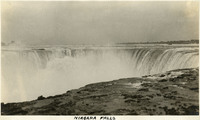 McCarthy Album 09, Photograph 121
 Caption: "Niagara Falls," c. 1925. View of Horseshoe Falls, the largest of the three waterfalls that make up the iconic Niagara Falls straddling the border between Ontario, Canada, and the State of New York.
-
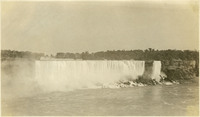 McCarthy Album 09, Photograph 120
 No caption. c. 1925. View of the American Falls (widest waterfall in the photograph), and Bridal Veil Falls, two of the three waterfalls that make up the iconic Niagara Falls straddling the border between Ontario, Canada, and the State of New York.
-
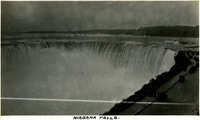 McCarthy Album 09, Photograph 119
 Caption: "Niagara Falls," c. 1925. View of Horseshoe Falls, largest of the three waterfalls that make up the iconic Niagara Falls straddling the border between Ontario, Canada, and the State of New York. At the right side of the photograph is a parking area with groups of tourists taking in the view.
-
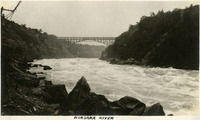 McCarthy Album 09, Photograph 118
 Caption: "Niagara River," c. 1925. The Whirlpool Rapids Bridge can be seen in this view of the Niagara River. The two-deck arch bridge, opened in 1897, connects the towns of Niagara Falls, Ontario, Canada, and Niagara Falls, New York.
-
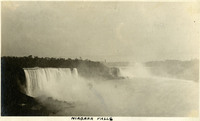 McCarthy Album 09, Photograph 117
 Caption: "Niagara Falls," c. 1925. View of the three waterfalls that make up the iconic Niagara Falls straddling the border between Ontario, Canada, and the State of New York. From left to right, the falls are called American Falls, Bridal Veil Falls (the smallest of the three), and Horseshoe Falls.
-
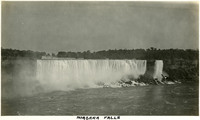 McCarthy Album 09, Photograph 116
 Caption: "Niagara Falls," c. 1925. View of the American Falls (widest waterfall in the photograph), and Bridal Veil Falls, two of the three waterfalls that make up the iconic Niagara Falls straddling the border between Ontario, Canada, and the State of New York.
-
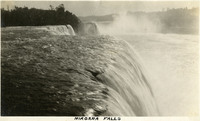 McCarthy Album 09, Photograph 115
 Caption: "Niagara Falls," c. 1925. View of the three waterfalls that make up the iconic Niagara Falls straddling the border between Ontario, Canada, and the State of New York. From near distance to far distance, the falls are called American Falls, Bridal Veil Falls (the smallest of the three), and Horseshoe Falls.
-
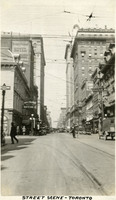 McCarthy Album 09, Photograph 114
 Caption: "Street Scene - Toronto," c. 1925. A bustling scene on an unidentified street in Toronto, Ontario.
-
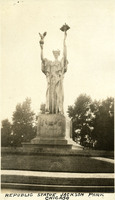 McCarthy Album 09, Photograph 113
 Caption: "Republic Statue Jackson Park Chicago," c. 1925. Designed by Chester French (sculptor), this version of the Statue of the Republic has stood in Chicago's Jackson Park since its construction in 1918. It is a one-third replica of a statue at the World's Columbian Exposition, held at Chicago in 1893.
-
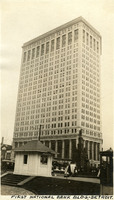 McCarthy Album 09, Photograph 112
 Caption: "First National Bank Bldg. - Detroit," c. 1925. When this building, designed by architect Albert Kahn in the Neoclassical style, was completed in 1922, it was Detroit's tallest structure. This photograph was taken before construction in 1926-27 of a twenty-five story addition adjacent to the building in this photograph.
-
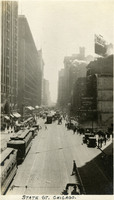 McCarthy Album 09, Photograph 111
 Caption: "State St. Chicago.," c. 1925. A busy street scene with people, cars and trollies.
-
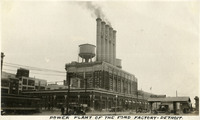 McCarthy Album 09, Photograph 110
 Caption: "Power Plant of the Ford Factory - Detroit," c. 1925. View of the power house at Ford's Highland Park Plant (considered to be the birthplace of the industrial assembly line). The plant's five smoke stacks have a "FORD" sign across them, flanked by two water towers.
-
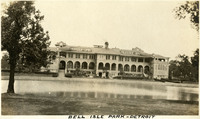 McCarthy Album 09, Photograph 109
 Caption: "Bell [sic] Isle Park - Detroit," c.1925. This photograph features the Belle Isle Casino, on the edge of Lake Tacoma on Belle Isle, in the Detroit River. The building is the second structure at the site, built in 1908 to replace a dilapidated wooden structure. The building is not a gambling facility, but is instead called a "casino" in the older sense of the word: a public building for meetings, dancing, reunions, and other recreation.
-
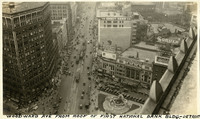 McCarthy Album 09, Photograph 108
 Caption: "Woodward Ave From Roof of First National Bank Bldg. - Detroit," c. 1925. Bird's eye view of a bustling street scene along Detroit's Woodward Ave.
-
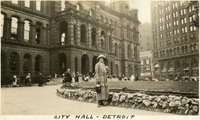 McCarthy Album 09, Photograph 107
 Caption: "City Hall - Detroit," c. 1925. Grace McCarthy poses in front of Detroit's City Hall. The Italian Renaissance Revival-style building, designed by architect James Anderson, was constructed between 1867 and 1871. It housed Detroit's city government until 1955, when a new facility was ready for occupation. This building was subsequently demolished in 1961.
-
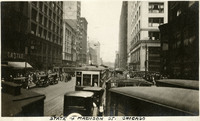 McCarthy Album 09, Photograph 106
 Caption: "State & Madison St. Chicago," c. 1923. A busy street scene at the intersection of State and Madison Streets in Chicago.
-
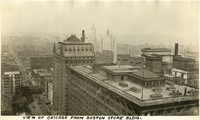 McCarthy Album 09, Photograph 105
 Caption: "View of Chicago From Boston Store Bldg," c. 1923. State Street, the Chicago Theatre, and the Wrigley Building (still under construction) can be seen in this bird's eye view of Chicago.
-
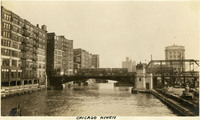 McCarthy Album 09, Photograph 104
 Caption: "Chicago River," c. 1923. A train crosses Michigan Avenue Bridge over the Chicago River in this photograph. The bascule bridge, engineered by the Chicago Department of Public Works, Bureau of Engineering, opened to traffic in 1920.
-
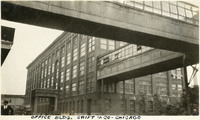 McCarthy Album 09, Photograph 103
 Caption: "Office Bldg. Swift & Co - Chicago," c. 1923. The general office of Chicago's Swift and Co., founded by meat packing magnate Gustavus Franklin Smith, Sr. in the late nineteenth century.
-
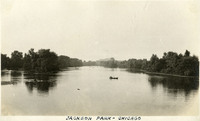 McCarthy Album 09, Photograph 102
 Caption: "Jackson Park - Chicago," c. 1923. The Grand Basin at Jackson Park. This 500-acre park was originally designed for use as the site of the World's Columbian Exposition (also called the Chicago World's Fair), held in 1893. The Grand Basin was a large reflecting pool at the center of the Exposition, around which the main buildings were constructed.
-
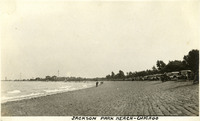 McCarthy Album 09, Photograph 101
 Caption: "Jackson Park Beach - Chicago," c. 1923. Jackson Park Beach at Lake Michigan, with a line of automobiles parked along the adjacent roadway.
-
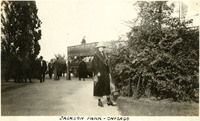 McCarthy Album 09, Photograph 100
 Caption: "Jackson Park - Chicago," c. 1923. Grace McCarthy poses for a photograph in Jackson Park while people behind her board a double decker bus.
-
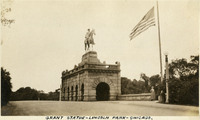 McCarthy Album 09, Photograph 099
 Caption: "Grant Statue - Lincoln Park - Chicago," c. 1923. Installed in 1891, the Ulysses S. Grant Memorial, created by Louis Rebisso (sculptor), is located in the east end of Chicago's Lincoln Park Zoo. It commemorates Ulysses S. Grant, former U.S. Army General and 18th President of the U.S.
-
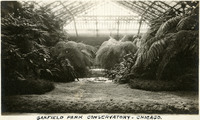 McCarthy Album 09, Photograph 098
 Caption: "Garfield Park Conservatory - Chicago," c. 1925. Construction began on the Garfield Park Conservatory in 1906. Opened to the public in 1908, the Conservatory is one of the largest greenhouse conservatories in the United States.
-
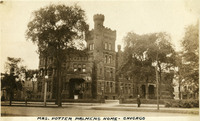 McCarthy Album 09, Photograph 097
 Caption: "Mrs. Potter Palmers [sic] Home - Chicago," c. 1923. Constructed between 1882-1885, Palmer Mansion was once the largest private residence in Chicago. It was demolished in 1950.
-
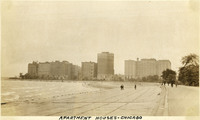 McCarthy Album 09, Photograph 096
 Caption: "Apartment Houses - Chicago," c. 1923. Apartment buildings near the shores of Lake Michigan.
-
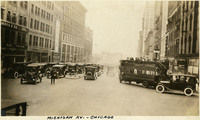 McCarthy Album 09, Photograph 095
 Caption: "Michigan AV. - Chicago," c. 1923. Michigan Avenue filled with cars, a double decker bus, and a traffic officer.
-
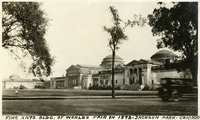 McCarthy Album 09, Photograph 094
 Caption: "Fine Arts Bldg. of Worlds Fair in 1893 - Jackson Park - Chicago," c. 1923. The Palace of Fine Arts building shown in this photograph was originally constructed for the World's Columbian Exposition held in Chicago in 1893. After the fair's completion, the building housed the Columbian Museum, which eventually became the Field Museum of Natural History. In 1920, that museum moved to a new building, and the Palace of Fine Arts building was left vacant. After renovations in the late 1920s, the Museum of Science and Industry opened at the site.
-
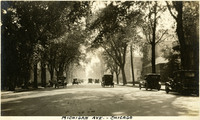 McCarthy Album 09, Photograph 093
 Caption: "Michigan Ave. - Chicago," c. 1923. A tree- lined Michigan Avenue filled with cars.
-
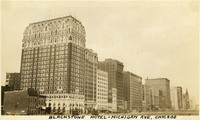 McCarthy Album 09, Photograph 092
 Caption: "Blackstone Hotel - Michigan Ave. Chicago," c. 1923. Built in 1909 and designed by Benjamin Marshall, the twenty-one story Blackstone Hotel sits on the corner of Michigan Avenue and Balbo Drive in Chicago Illinois. It is the building closest to the left side of the photograph in this row of high-rises. See also 96-07-08-alb04-074.
-
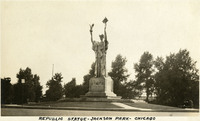 McCarthy Album 09, Photograph 091
 Caption: "Republic Statue - Jackson Park - Chicago," c. 1923. Designed by Chester French (sculptor), this version of the Statue of the Republic has stood in Chicago's Jackson Park since its construction in 1918. It is a one-third replica of a statue at the World's Columbian Exposition, held at Chicago in 1893.
-
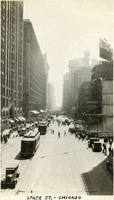 McCarthy Album 09, Photograph 090
 Caption: "State St. - Chicago," c. 1923. A busy street scene with people, automobiles, and trollies.
-
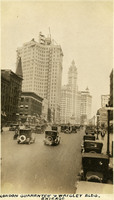 McCarthy Album 09, Photograph 089
 Caption: "London Guarantee & Wrigley Bldg. Chicago," c. 1923. This photograph, taken at street level, features the London Guarantee Building (with the small cupola still under construction at its top) and the Wrigley Building (just to the right of the London Guarantee Building). The London Guarantee Building (also called the London Guaranty and Accident Building), designed by Alfred S. Alschuler, was completed in 1923. The Wrigley Building, constructed by the famous chewing gum magnate William Wrigley, Jr., consists of two towers. The south tower was completed in 1921, while the north tower was finished in 1924 (you can make out construction scaffolding on the top of the tower in this photograph).
-
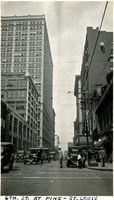 McCarthy Album 09, Photograph 088
 Caption: "6th. St. At Pine - St. Louis," c. 1923. A bustling street scene on 6th Street in St. Louis, at its intersection with Pine.
-
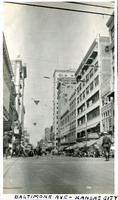 McCarthy Album 09, Photograph 087
 Caption: "Baltimore Ave - Kansas City," c. 1923. A busy street scene on Baltimore Ave in Kansas City.
-
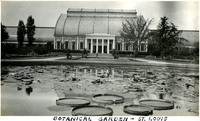 McCarthy Album 09, Photograph 086
 Caption: "Botanical Garden - St. Louis," c. 1923. View of the Palm House, built in 1915 to house tropical plants in the Missouri Botanical Gardens in St. Louis. It was torn down in 1959 to make room for the domed geodesic Climatron building which still stands at the site. See also 96-07-08-alb04-091.
-
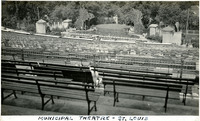 McCarthy Album 09, Photograph 085
 Caption: "Municipal Theatre - St. Louis," c. 1923. Built in 1917, the St. Louis Municipal Opera Theatre was the first municipally-owned outdoor theatre in the United States. The amphitheater seats 11,000 people, and is still in use today.
-
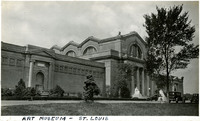 McCarthy Album 09, Photograph 084
 Caption: Art Museum - St. Louis," c. 1923. The Saint Louis Art Museum features elements of the Greek Revival style. It began life as the Palace of Fine Arts for the World's Fair held in St. Louis in 1904. The museum moved into the building after the fair's completion.
-
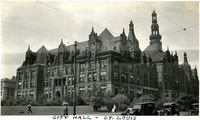 McCarthy Album 09, Photograph 083
 Caption: "City Hall - St. Louis," c. 1923. Grace McCarthy poses in front of the St. Louis City Hall, while a man mows the lawn and an adult and child stroll on the sidewalk. The French Renaissance Revival style building, designed by George Richard Mann, has been home to the city's governmental offices since 1898.
-
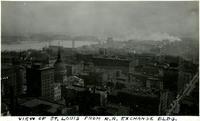 McCarthy Album 09, Photograph 082
 Caption: "View of St. Louis from R.R. Exchange Bldg," c. 1923. Merchant's Bridge and the Old Courthouse (domed building just to left of center) can be seen in this bird's eye view of St. Louis.
-
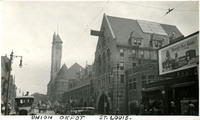 McCarthy Album 09, Photograph 081
 Caption: "Union Depot St. Louis," c. 1923. Opened in 1894, the St. Louis Union Depot was designated a National Historic Landmark in 1970. Designed by Theodore Link, the building features a 280-foot-tall clock tower. At the time of its construction, it was the largest, busiest railroad station in the world.
-
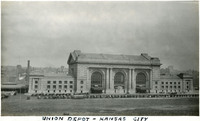 McCarthy Album 09, Photograph 080
 Caption: "Union Depot - Kansas City," c. 1923. This Beaux Arts-style rail station opened in 1914, replacing a small depot from 1871. Decreasing rail passenger traffic after World War II resulted in the closure of the depot in 1985. However, the restored depot later reopened in 1999, containing museums and other attractions. In 2002, it was again put to service as a rail depot when Amtrak again brought passenger trains to the area.
-
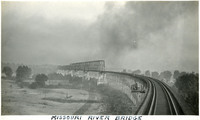 McCarthy Album 09, Photograph 079
 Caption: "Missouri River Bridge," c. 1923. The Union Pacific Missouri River Bridge connects Council Bluffs, Iowa, with Omaha, Nebraska. The rail truss bridge was the third in the location, opening in 1916.
-
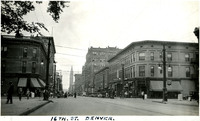 McCarthy Album 09, Photograph 078
 Caption: "16th. St. Denver," c. 1923. A bustling scene of cars and people on Denver's 16th street.
-
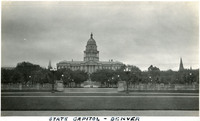 McCarthy Album 09, Photograph 077
 Caption: "State Capitol - Denver," c. 1923. The Colorado State Capitol in Denver is a Neoclassical building built from Colorado rose onyx, a stone so rare that all known reserves were used in the capitol's construction. Designed by Elijah E. Myers, it was first occupied in 1894.
-
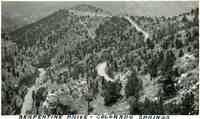 McCarthy Album 09, Photograph 076
 Caption: "Serpentine Drive - Colorado Springs," c. 1923. A bird's eye view of Serpentine Drive, a twisty mountain road near Manitou Springs and Colorado Springs.
-
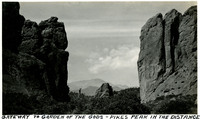 McCarthy Album 09, Photograph 075
 Caption: "Gateway to Garden of the Gods - Pikes Peak in the Distance," c. 1923. Two massive rock formations rise on either side of this photograph, bracketing Pikes Peak in the distance. The Garden of the Gods, a region of spectacular red rock formations in Colorado, was designated a National Natural Landmark in 1971.
-
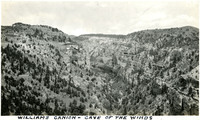 McCarthy Album 09, Photograph 074
 Caption: "Williams Canion [sic] - Cave of the Winds," c. 1923. View of a rugged canyon with a small building perched on one wall featuring a sign reading "CAVE." In 1880, two brothers, George and John Pickett, discovered the entrance to a large cave system in Williams Canyon. Further exploration resulted in opening more caverns within the system. The site became a tourist attraction called "Cave of the Winds," with guided tours having been on offer since 1881.
-
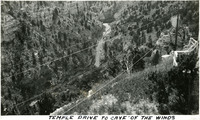 McCarthy Album 09, Photograph 073
 Caption: "Temple Drive to Cave of the Winds," c. 1923. Bird's eye view of a road at the bottom of a canyon, on a drive to Cave of the Winds. Two brothers discovered the entrance to the large cave system in 1880, in Williams Canyon just outside of Manitou Springs. Further exploration resulted in opening more caverns within the system, and the site became a tourist attraction, with guided tours having been on offer since 1881.