-
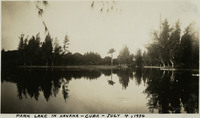 McCarthy Album 11, Photograph 122
 Caption: "Park Lake in Havana -- Cuba -- July 4, 1934." A calm lake surrounded by trees and other vegetation.
-
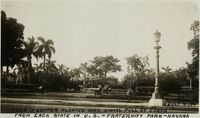 McCarthy Album 11, Photograph 121
 Caption: "Tree in Center Planted with Shovel Full of Earth From Each State in U.S. -- Fraternity Park -- Havana, July 4, 34." This photograph captures a view of Havana's Fraternity Park. The area originally served the city as a military parade and training ground (called Campo de Marte). In 1928, the park was renovated and a ceiba (or kapok) tree was planted in one of the central parcels. This tree, seen in the center of this photograph, was planted as the Tree of American Fraternity. When Havana hosted the sixth International American Conference later in 1928 (also known as one of the Pan-American Conferences), each of the twenty-one visiting dignitaries brought earth from their native counties in which to plant the tree (William McCarthy mistakenly identified the earth as coming from each state in the U.S.).
-
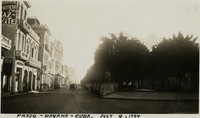 McCarthy Album 11, Photograph 120
 Caption: "Prado -- Havana -- Cuba. July 4, 1934." Street scene in Havana. A park appears at the right of the photograph, while buildings line the left side of the street.
-
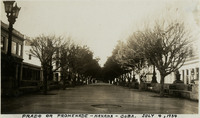 McCarthy Album 11, Photograph 119
 Caption: "Prado or Promenade -- Havana -- Cub. July 4, 1934." Street scene, with a wide street lined with marble benches and trees on both sides. The Paseo del Prado is the oldest paved street in Havana, marking the line between Centro Habana and Old Havana. Its route was established in 1772 by Don Felipe Fonsdeviela y Ondeano. The street was redesigned in 1925 by landscape architect Jean-Claude Nicolas Forestier (who added the trees and marble benches).
-
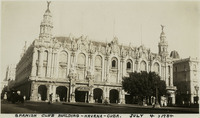 McCarthy Album 11, Photograph 118
 Caption: "Spanish Club Building -- Havana -- Cuba. July 4, 1934." View of the Centro Gallago, now called "Gran Teatro de La Habana," or "Great Theatre of Havana," completed in 1915. It serves as the headquarters for the Cuban National Ballet Company.
-
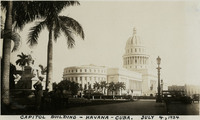 McCarthy Album 11, Photograph 117
 Caption: "Capitol Building -- Havana -- Cuba. July 4, 1934." The building seen in this photograph, reminiscent of the U.S. Capitol, served as Cuba's Capitol from its completion in 1929 until after the Cuban Revolution of 1959. Designed by Eugenio Rayneri Piedra, the building now houses the Cuban Academy of Sciences.
-
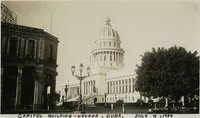 McCarthy Album 11, Photograph 116
 Caption: "Capitol Building -- Havana, Cuba. July 4, 1934." The building seen in this photograph, reminiscent of the U.S. Capitol, served as Cuba's Capitol from its completion in 1929 until after the Cuban Revolution of 1959. Designed by Eugenio Rayneri Piedra, the building now houses the Cuban Academy of Sciences.
-
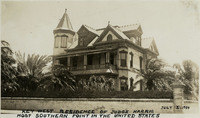 McCarthy Album 11, Photograph 115
 Caption: "Key West Residence of Judge Harris, Most Southern Point in the United States July 2, 1934." View of the Queen Anne-style Victorian mansion constructed in Key West by Judge Vinning Harris in 1897. The home was originally touted as occupying the southernmost point in the U.S., resulting in the colloquial name "Southernmost House." During the Prohibition years (1920-1933) the house operated as a speakeasy, with a restaurant and casino. In 1939, it was converted to use as a nightclub. Today, it has been renovated for use as a bed-and-breakfast.
-
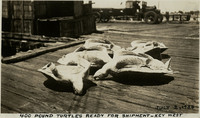 McCarthy Album 11, Photograph 114
 Caption: "400 Pound Turtles Ready for Shipment -- Key West July 2, 1934." Several slaughtered sea turtles on a wharf in Key West. Turtle meat and eggs were popular food items in the early-to-mid twentieth century; turtle fat was especially prized for making turtle soup. Turtle kraals (corrals) and a cannery were built as the Key West area began to develop. However, the turtle population plummeted in the Florida Keys and surrounding areas as the twentieth century progressed and demand for turtle meat, eggs, and fat increased. The Key West turtle fishing industry halted after the Endangered Species Act was passed in 1971. Turtle populations have since started to recover. The cannery now serves as the Key West Turtle Museum.
-
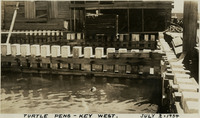 McCarthy Album 11, Photograph 113
 Caption: "Turtle Pens -- Key West. July 2, 1934." View of turtle kraals, or turtle corrals, used in the turtle fishing industry in Key West. Green turtles were kept in these pens prior to slaughter or transport. Turtle meat and eggs were popular food items in the early-to-mid twentieth century; turtle fat was especially prized for making turtle soup. However, the turtle population plummeted in the Florida Keys and surrounding areas as the twentieth century progressed and demand increased. The turtle kraals and nearby canneries closed when the Endangered Species Act was passed in 1971. Populations have since started to recover. The cannery near the kraals shown in this photograph now serves as the Key West Turtle Museum.
-
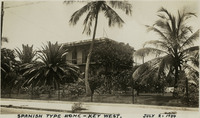 McCarthy Album 11, Photograph 112
 Caption: "Spanish Type Home -- Key West. July 2, 1934." View of a multi-story residence in Key West. Much of the building is obscured by surrounding vegetation.
-
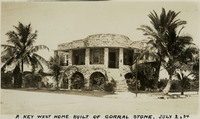 McCarthy Album 11, Photograph 111
 Caption: "A Key West Home Built of Corral [sic] Stone. July 2, 34." View of a multi-story residence made of coral.
-
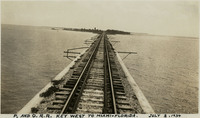 McCarthy Album 11, Photograph 110
 Caption: "P. and O. R.R. Key West to Miami -- Florida. July 2, 1934." View of railroad tracks running over water to an island in the distance. This is likely part of the Overseas Railroad, an extension of the Florida East Coast Railway, built to connect Key West with the Florida mainland.
-
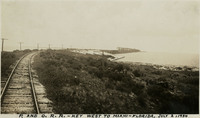 McCarthy Album 11, Photograph 109
 Caption: "P. and O. R.R. -- Key West to Miami -- Florida. July 2, 1934." View of railroad tracks carried on a berm in the foreground and on a trestle over water in the distance. This is likely part of the Overseas Railroad, an extension of the Florida East Coast Railway, built to connect Key West with the Florida mainland.
-
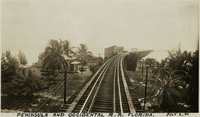 McCarthy Album 11, Photograph 108
 Caption: "Peninsula and Occidental R.R. Florida. July 2, 34." View of railroad tracks carried over water into the distance on a wood trestle. This is likely part of the Overseas Railroad, an extension of the Florida East Coast Railway, built to connect Key West with the Florida mainland.
-
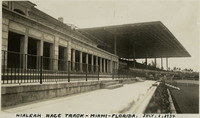 McCarthy Album 11, Photograph 107
 Caption: "Hialeah Race Track -- Miami -- Florida July 1, 1934." View of the grandstand at Hialeah Park Race Track. Constructed in 1922 as a greyhound racetrack, Hialeah began hosting horse races in 1925. Joseph E. Widener purchased the track in 1930. He embarked upon a series of improvements, adding a grandstand (seen here) and clubhouse facilities designed by Lester W. Geisler, as well as landscaped gardens and a lake in the infield that became home to a flock of flamingos. The new and improved Hialeah track, now called Hialeah Park, officially opened in 1932.
-
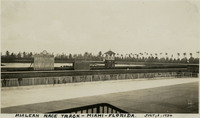 McCarthy Album 11, Photograph 106
 Caption: "Hialeah Race Track -- Miami -- Florida July 1, 1934." View of the infield at Hialeah Park Race Track. Constructed in 1922 as a greyhound racetrack, Hialeah began hosting horse races in 1925. Joseph E. Widener purchased the track in 1930. He embarked upon a series of improvements, adding a grandstand (seen here) and clubhouse facilities designed by Lester W. Geisler, as well as landscaped gardens and a lake in the infield that became home to a flock of flamingos. The new and improved Hialeah track, now called Hialeah Park, officially opened in 1932.
-
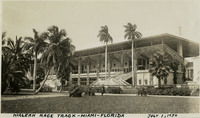 McCarthy Album 11, Photograph 105
 Caption: "Hialeah Race Track -- Miami -- Florida July 1, 1934." Grace McCarthy standing behind the grandstand at Hialeah Park Race Track, in Hialeah (near Miami). Constructed in 1922 as a greyhound racetrack, Hialeah began hosting horse races in 1925. Joseph E. Widener purchased the track in 1930. He embarked upon a series of improvements, adding a grandstand (seen here) and clubhouse facilities designed by Lester W. Geisler, as well as landscaped gardens and a lake in the infield that became home to a flock of flamingos. The new and improved Hialeah track, now called Hialeah Park, officially opened in 1932.
-
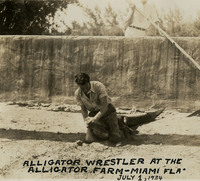 McCarthy Album 11, Photograph 104
 Caption: "Alligator Wrestler at the Alligator Farm -- Miami Fla. July 1, 1934." Unidentified man kneeling with his knees entrapping an alligator, and holding its mouth closed with his hands.
-
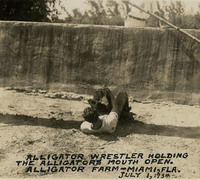 McCarthy Album 11, Photograph 103
 Caption: "Alligator Wrestler Holding the Alligators Mouth Open. Alligator Farm -- Miami, Fla. July 1, 1934." Unidentified man lying on his back, holding an alligator between his legs and forcing its mouth open to expose its teeth.
-
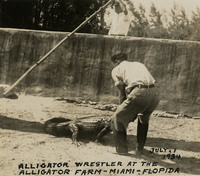 McCarthy Album 11, Photograph 102
 Caption: "Alligator Wrestler at the Alligator Farm -- Miami -- Flopida [sic] July, [sic] 1 1934." An unidentified man grasps an alligator by the snout in this photograph.
-
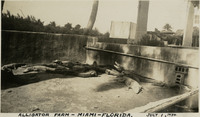 McCarthy Album 11, Photograph 101
 Caption: "Alligator Farm -- Miami -- Florida. July 1, 1934." View of a holding pen at an alligator farm, with over a dozen alligators sunbathing.
-
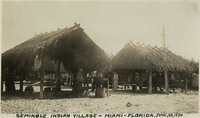 McCarthy Album 11, Photograph 100
 Caption: "Seminole Indian Village -- Miami -- Florida. June, [sic] 30, 1934." Several shelters with roofs of thatched grass or brush, with several unidentified women and children scattered throughout the photograph. The Seminoles are a Native American tribe from Florida, although most of the tribe had been forcibly relocated from Florida to Oklahoma by 1842. Fewer than 200 remained in Florida after the Third Seminole War ended in 1858, but a resurgence of the tribe occurred in the early to mid twentieth century. The Florida Seminole tribe received federal recognition in 1957.
-
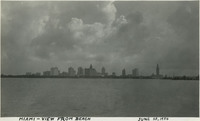 McCarthy Album 11, Photograph 099
 Caption: "Miami -- View from Beach, June 30, 1934." View of Miami's skyline from across a stretch of ocean. The Miami-Biltmore Hotel can be seen in the center of the photograph, with the Miami-Dade County Courthouse just to its right.
-
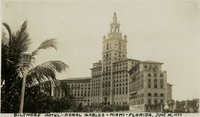 McCarthy Album 11, Photograph 098
 Caption: "Biltmore Hotel -- Coral Gables -- Miami -- Florida. June 30, 1934." View of the Miami Biltmore Hotel in Coral Gables, part of the Bowman-Biltmore hotel chain. The luxury hotel, designed by Schultze and Weaver, was the tallest building in Florida at the time of its completion in 1926. It held this record until 1928, when the Miami-Dade Courthouse was constructed.
-
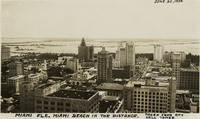 McCarthy Album 11, Photograph 097
 Caption: "Miami Fla. Miami Beach in the Distance. Taken from City Hall Tower, June 30, 1934." Bird's eye view of Miami, with the ocean in the distance. This photograph was likely taken from atop the Miami-Dade Courthouse rather than City Hall.
-
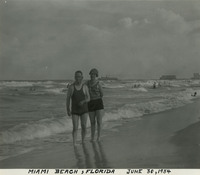 McCarthy Album 11, Photograph 096
 Caption: "Miami Beach, Florida. June 30 1934." William and Grace McCarthy posing on a beach at the ocean's edge, with surf foaming around their ankles.
-
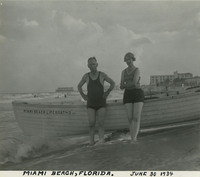 McCarthy Album 11, Photograph 095
 Caption: "Miami Beach, Florida. June 30 1934." William and Grace McCarthy posing in front of a Miami Beach lifeboat, with surf foaming around their ankles.
-
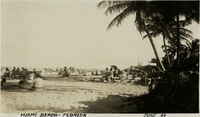 McCarthy Album 11, Photograph 094
 Caption: "Miami Beach -- Florida, June 30." Crowded beach scene with palm trees at the right and the water in the distance to the left.
-
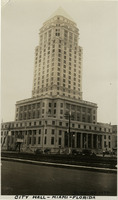 McCarthy Album 11, Photograph 093
 Caption: "City Hall -- Miami -- Florida, June 30 1934." This photograph depicts the Miami-Dade County Courthouse (not Miami's City Hall). Designed by architect A. Ten Eyck Brown, the Courthouse was constructed between 1925-1928. At the time of its construction, it was the tallest building in Florida.
-
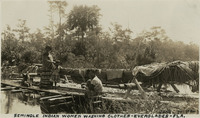 McCarthy Album 11, Photograph 092
 Caption: "Seminole Indian Women Washing Clothes -- Everglades -- Fla. June 30, 1934." Two unidentified women and a small child washing clothing. Several articles of clothing are spread out to dry on a canoe lifted off the ground by sawhorses made of logs. They are likely Seminoles, a Native American tribe in Florida, although most of the tribe had been forcibly relocated from Florida to Oklahoma by 1842. Fewer than 200 remained in Florida after the Third Seminole War ended in 1858, but a resurgence of the tribe occurred in the early to mid twentieth century. The Florida Seminole tribe received federal recognition in 1957.
-
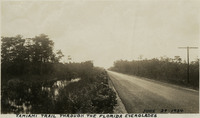 McCarthy Album 11, Photograph 091
 Caption: "Tamiami Trail Through the Florida Everglades, June 27, 1934." Asphalt-paved road stretching into the distance, flanked on one side by a canal. The Tamiami Trail constitutes a scenic portion of what is now U.S. Highway 41. Work on a road connecting Tampa with Miami began in 1915, but the Trail was not officially opened until 1928. Work on the route required building across a portion of the massive swamp system of the Everglades. Workers dredged and blasted a canal along the route, and used the fill dirt thus removed to construct the roadway proper.
-
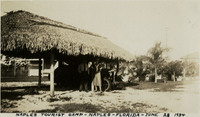 McCarthy Album 11, Photograph 090
 Caption: "Naples Tourist Camp -- Naples -- Florida -- June 28 1934." William and Grace McCarthy standing near an automobile parked in a thatched shelter.
-
 McCarthy Album 11, Photograph 089
 Caption: "Stret [sic] Leading to Fords and Edisons Winter Homes, Fort Meyers -- Florida June 28, 1934." Paved street lined by palms and lush vegetation. This road is likely McGregor Boulevard in Fort Meyers. Thomas Edison and Henry Ford purchased adjacent properties in Fort Meyers and built vacation or winter homes that were opened to the public for tours in 1947 and 1990, respectively. The two properties are now known collectively as the Edison and Ford Winter Estates.
-
 McCarthy Album 11, Photograph 088
 Caption: "Ringling Museum -- Sarasota -- Florida, June 28 1934." Entrance to the John and Mable Ringling Museum of Art, Florida's state art museum established by John and Mable Ringling in 1927. John was a promoter and part-owner of the famous Ringling Brothers Circus, along with four of his brothers. When John and Mable built a winter home in Sarasota in 1926, they also explored the possibility of establishing an art gallery on the same property. Architect John H. Phillips designed the building, which opened to the public in 1931. John Ringling willed the facility and the art collection to the state of Florida upon his death in 1936. The museum, now known simply as "The Ringling," is under the jurisdiction of the University of Florida.
-
 McCarthy Album 11, Photograph 087
 Caption: "Street Scene -- Clearwater -- Florida -- June 27, 1934." Residential street in Clearwater, Florida (incorporated in 1891). The street is lined by palm trees and has wide grass verges on either side. A bicycle has been temporarily forgotten at the left-hand side of the photograph.
-
 McCarthy Album 11, Photograph 086
 Caption: "Bay Shore [sic] Boulevard -- Tampa -- Florida -- June 27, 1934." Street scene along Bayshore Boulevard in Tampa, showing a cobbled street lined by large residences.
-
 McCarthy Album 11, Photograph 085
 Caption: "Lakeland Florida June 26, 1934." View of the skyline of Lakeland across Mirror Lake. Founded by Abraham Munn and incorporated in 1885, the city of Lakeland is located east of Tampa.
-
 McCarthy Album 11, Photograph 084
 Caption: "Mountain Lake, Bok Singing Tower in the Distance -- Florida, June 26, 1934." Lake scene, with lush vegetation and the Singing Tower of Bok Tower Gardens visible in the center of the photograph. Mountain Lake, named for the lake near which it was established, was founded by Frederick S. Ruth in 1916.
-
 McCarthy Album 11, Photograph 083
 Caption: "Bok Singing Tower, Lake Wales -- Florida, June 26, 1934." View of the Bok Singing Tower in the Bok Tower Gardens, a 250-acre contemplative garden and bird sanctuary dedicated in 1929. The 205-foot-tall tower, designed by architect Milton B. Medary, was completed by February 1929. It features Gothic Revival and Art Deco detailing. A 60-bell carillon can be played by a clavier (keyboard) in the bell chamber.
-
 McCarthy Album 11, Photograph 082
 Caption: "Florida Highway. June 26, 1934." Tall trees, many hung with Spanish moss, line this unidentified Florida highway.
-
 McCarthy Album 11, Photograph 081
 Caption: "Lake Dora near Mt. Dora -- Florida, June 26, 1934." View of Lake Dora, near the town of Mount Dora in Florida. Grace McCarthy can be seen standing next to an automobile in the lower left-hand corner of the photograph. Mount Dora, settled in 1874, is thus named because the town sits on a low plateau approximately 184 feet above sea level, an unusual feature in a state whose mean elevation above sea level is 100 feet.
-
 McCarthy Album 11, Photograph 080
 Caption: "Florida Orange Groves -- Orlando, Florida, June 26, 1934." Orange groves line a road near Orlando in this photograph.
-
 McCarthy Album 11, Photograph 079
 Caption: "Negro Hut Near Orlando -- Florida -- June 25 1934." An unidentified man and woman stand on the front porch of a small home with wood siding and a corrugated metal roof.
-
 McCarthy Album 11, Photograph 078
 Caption: "Bok Singing Tower, Lake Wales -- Florida, June 26, 34." William McCarthy stands in Bok Tower Gardens, a 250-acre contemplative garden and bird sanctuary dedicated in 1929. The centerpiece of the gardens appears behind William: the Bok Singing Tower. The 205-foot-tall tower, designed by architect Milton B. Medary, was completed by February 1929. It features Gothic revival and Art Deco detailing. A 60-bell carillon can be played by a clavier (keyboard) in the bell chamber.
-
 McCarthy Album 11, Photograph 077
 Caption: "In Memory of Florida Confederates, Memorial Monument -- Pensacola Florida, June 21, 34." Photograph of the pillar and statue erected in Pensacola's Lee Square in 1891, memorializing "the Uncrowned Heroes of the Southern Confederacy" and Confederate leaders such as Jefferson Davis. Two low pyramids made up of cannon balls bracket the monument. As of the time of this writing (November 2017), controversy swirls around efforts to remove the memorial.
-
 McCarthy Album 11, Photograph 076
 Caption: "Oklahawaha [sic] River at Silver Springs -- Florida, June 24, 34." View of a placid Ocklawaha River flowing by a lush park on the bank opposite the photographer.
-
 McCarthy Album 11, Photograph 075
 Caption: "Silver Springs -- Florida, June 24, 1934." Grace McCarthy seated in a gazebo with a conical roof sheathed in grass or brush. Silver Springs, a series of artesian springs in Marion County, was Florida's first tourist attraction. The area began to attract visitors after the Civil War, in the late 1860s. In the late 1870s, entrepreneurs started offering glass-bottom boat tours of the springs. The locale became popular in the 1930s with film producers: several of the original Tarzan movies were filmed here, as was the Creature from the Black Lagoon (1954).
-
 McCarthy Album 11, Photograph 074
 Caption: "Sugar Cane and Cotton Fields -- Florida, June 23, 34." A sugar cane field (at left) borders a cotton field (at right) in this photograph.
-
 McCarthy Album 11, Photograph 073
 Caption: "Suwannee River -- Florida, June 23, 1934." William and Grace McCarthy posing beneath a sign reading "'Way Down Upon The Suwannee River', Stephen Foster," referring to the minstrel song written by Foster in 1851. The Suwannee River flows by in the background.