-
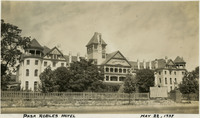 McCarthy Album 10, Photograph 005
 Caption: "Pasa [sic] Robles Hotel, May 22, 1935." View of the Hotel el Paso de Robles (pass of the oaks). This resort hotel opened in 1891, and featured a variety of amenities including a mineral hot springs "plunge" bath. The hotel burned down in 1940, and was replaced by the building that is still in operation today as the Paso Robles Inn.
-
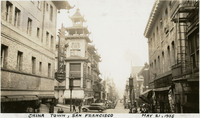 McCarthy Album 10, Photograph 004
 Caption: "China Town, San Francisco, May 21, 1935," shows a busy street scene in the Chinese district of San Francisco.
-
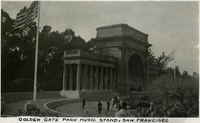 McCarthy Album 10, Photograph 003
 Caption: "Golden Gate Park Music Stand, San Francisco."
-
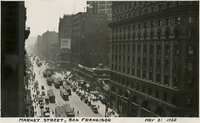 McCarthy Album 10, Photograph 002
 Caption: "Market Street, San Francisco, May 21, 1935," shows the busy thoroughfare with the San Francisco Chronicle building on the right.
-
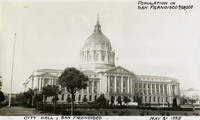 McCarthy Album 10, Photograph 001
 Caption: "City Hall, San Francisco, Population in San Francisco 750,000, May 21, 1935." The date with which the photograph was labeled (May 21, 1935) does not appear to be accurate. The date is more likely circa 1925. See also 96-07-08-alb09-003 and 005, and 96-07-08-alb11-001.
-
 McCarthy Album 10, Photograph 000k
 Caption: "Western States Tour - Left San Francisco May 21, 1935, Returned Sept. 10, 1935 - Traveled 7,124 Mi. Note Dark Line." The California State Automobile Association map of the U.S. shows the route that William and Grace McCarthy took during their 1935 tour of the western states, including national parks.
-
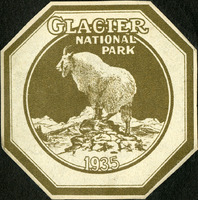 McCarthy Album 10, Photograph 000j
 No Caption: A Glacier National Park decal, 1935, octagon-shaped, olive green and white, with an image of a mountain goat standing on a rocky cliff.
-
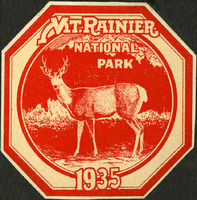 McCarthy Album 10, Photograph 000i
 No Caption: A Mt. Rainier National Park decal, 1935, octagon-shaped, red and white, with an image of a deer standing before Mt. Rainier.
-
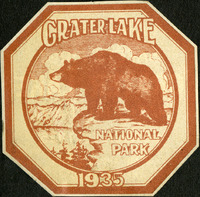 McCarthy Album 10, Photograph 000h
 No Caption: A Crater Lake National Park decal, 1935, octagon-shaped, brown and white, with an image of a bear on a cliff that with the lake below.
-
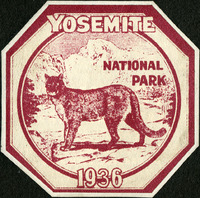 McCarthy Album 10, Photograph 000g
 No Caption: A Yosemite National Park decal, 1936, octagon-shaped, red and white, with an image of a mountain lion with Half Dome in the background.
-
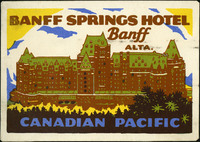 McCarthy Album 10, Photograph 000f
 No Caption: A decal for the "Banff Springs Hotel, Banff Alta, Canadian Pacific," c. 1935.
-
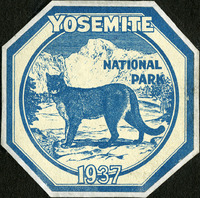 McCarthy Album 10, Photograph 000e
 No Caption: A Yosemite National Park decal, 1937, octagon-shaped, blue and white, with an image of a mountain lion with Half Dome in the background.
-
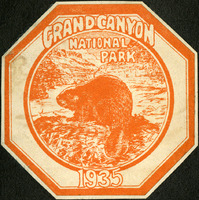 McCarthy Album 10, Photograph 000d
 No Caption: A Grand Canyon National Park decal, 1935, octagon-shaped, orange and white, with an image of a beaver surrounded by canyons.
-
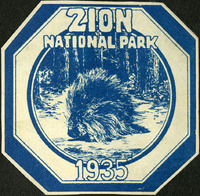 McCarthy Album 10, Photograph 000c
 No Caption: A Zion National Park decal, 1935, octagon- shaped, blue and white, with an image of a porcupine in a grove of pine trees.
-
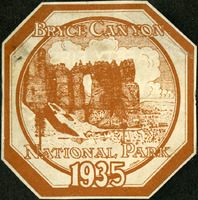 McCarthy Album 10, Photograph 000b
 No Caption: A Bryce Canyon National Park decal, 1935, octagon-shaped, orange and white, with an image of unique rock formations, trees, and clouds.
-
 McCarthy Album 10, Photograph 000a
 No Caption: A Yellowstone National Park decal, 1935, octagon-shaped, green and white, with an image of a buffalo in the foreground and mountain range in the background.
-
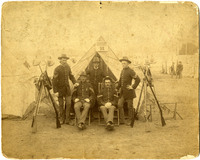 McCarthy Album 11, Photograph x007
 No caption, undated. Photograph of five unidentified men in military uniform, posing in front of a tent with a sign designating it as part of Company H. This photograph was loose in the box with Album 11.
-
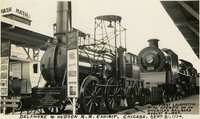 McCarthy Album 11, Photograph x006
 Caption: "Delaware & Hudson R.R. Exhibit. Chicago. Sept. 21, 1934. First Locomotive to Operate on an American Railroad, August 8, 1829." View of a replica of the Stourbridge Lion, the first steam locomotive to operate in the U.S., on lines built by the Delaware and Hudson Railway (formerly the Delaware and Hudson Canal Company). The replica was displayed at the 1934 Century of Progress Exposition, celebrating Chicago's one-hundred year anniversary of incorporation. This photograph was loose in the box with Album 11.
-
 McCarthy Album 11, Photograph x005
 Caption: "Ancient Locomotives. Chicago Fair. Sept. 21, 1934." This photograph shows two steam locomotives from the nineteenth and early twentieth centuries, on display at the 1934 Century of Progress Exposition in Chicago, celebrating that city's one-hundred year anniversary of incorporation. This photograph was loose in the box with Album 11.
-
 McCarthy Album 11, Photograph x004
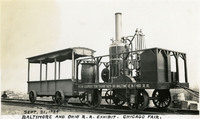
 Caption: "Sept. 21, 1934, Baltimore and Ohio R.R. Exhibit. Chicago Fair." Shows a replica of the Tom Thumb, an early steam locomotive built by Peter Cooper in 1830 for the Baltimore and Ohio Railroad. This replica was displayed at the Century of Progress Exposition in Chicago, a world's fair celebrating the city's one-hundred year anniversary of incorporation. This photograph was loose in the box with Album 11.
-
 McCarthy Album 11, Photograph x003
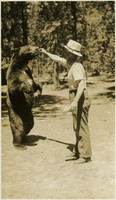
 No caption, c. 1935. William McCarthy is feeding a bear standing upright, likely in Yosemite National Park. This photograph was loose in the box with Album 11.
-
 McCarthy Album 11, Photograph x002
 No caption, undated. A locomotive steams through the center of this photograph, in an unidentified location. This photograph was loose in the box with Album 11.
-
 McCarthy Album 11, Photograph x001
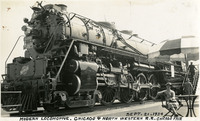
 Caption: "Modern Locomotive. Chicago & North Western R.R. Chicago Fair, Sept. 21, 1934." Grace McCarthy is seated next to a large locomotive of the Chicago and North Western Railroad while visiting the Century of Progress Exposition in Chicago. The locomotive was one of the new Class H 4-8-4 engines, capable of pulling either freight or passenger trains. These locomotives were among the heaviest of their class produced in America, and were dubbed the "Zeppelins of the Rails." This photograph was loose in the box with Album 11.
-
McCarthy Album 11, Photograph 334e
Image withheld due to copyright considerations. For more information, please contact the California State Archives Reference Desk at ArchivesWeb@sos.ca.gov or (916) 653-2246. Image is a map of the United States showing "Our 1934 United States Automobile Tour. Traveled 10,000 miles -- May 14 to Oct 9.th. Note the Blue Line for Route of Travel." The blue line stretches from San Francisco to Los Angeles, then along the southern portion of the U.S. into Florida, south to Havana, and then north along the East Coast until heading east from Boston. The route skirted the Great Lakes then struck out across the Great Plains, Colorado, and Nevada, before ending in San Francisco to complete the loop.
-
 McCarthy Album 11, Photograph 334d
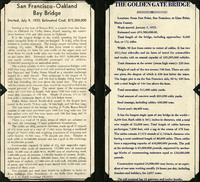
 No caption. Undated clippings from unidentified pamphlets or newspapers. The first describes the San Francisco-Oakland Bay Bridge, while the second provides details regarding the Golden Gate Bridge.
-
 McCarthy Album 11, Photograph 334c
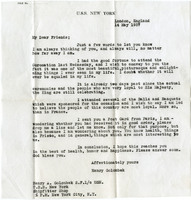
 No caption. Letter from Henry Golombeck of the U.S. Navy to William and Grace McCarthy, on the letterhead of the USS New York, dated May 14, 1937, and sent from London England.
-
McCarthy Album 11, Photograph 334b
Image withheld due to copyright considerations. For more information, please contact the California State Archives Reference Desk at ArchivesWeb@sos.ca.gov or (916) 653-2246. This postcard, sent to William and Grace McCarthy in May 1937, commemorates the coronation of George VI, King of Great Britain and Ireland, Defender of the Faith, Emperor of India. The back of the postcard features an image of the Hotel de Ville in Paris.
-
McCarthy Album 11, Photograph 334a
Image withheld due to copyright considerations. For more information, please contact the California State Archives Reference Desk at ArchivesWeb@sos.ca.gov or (916) 653-2246. This postcard, sent to William and Grace McCarthy in May 1937, commemorates the coronation of George VI, King of Great Britain and Ireland, Defender of the Faith, Emperor of India. The front of the postcard features both an American flag and the Union Jack of Great Britain.
-
 McCarthy Album 11, Photograph 333
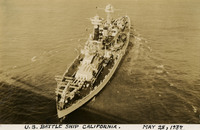
 Caption: "U.S. Battle Ship California. May 28, 1937." The USS California, a Tennessee-class dreadnaught battleship, was the fifth U.S. ship named after the Golden State. Launched in 1915, the California served as the Pacific Fleet's flagship for twenty years. The California was docked at Pearl Harbor when the Japanese attacked in 1941. Two bombs struck and eventually sunk her, killing ninety-eight of her crew and wounding sixty-one more. The California was subsequently refloated, with repairs done first at Pearl Harbor and then at Puget Sound Navy Yard. She then sailed to assist numerous campaigns in the Pacific Theater of the war, earning seven battle stars for this service. The California was decommissioned in 1947, and sold for scrapping in 1959.
-
 McCarthy Album 11, Photograph 332
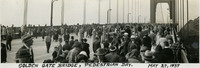
 Caption: "Golden Gate Bridge, Pedestrian Day. May 27, 1937." View of crowds walking across the just-completed Golden Gate Bridge as part of Pedestrian Day. Pedestrian Day kicked off the Golden Gate Bridge Fiesta celebrating the opening of the now-iconic bridge. Approximately 200,000 people walked or roller-skated across the bridge during the Pedestrian Day festivities, held the day before the bridge opened to vehicular traffic.
-
 McCarthy Album 11, Photograph 331
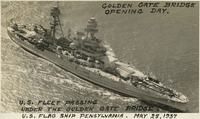
 Caption: "Golden Gate Bridge Opening Day. U.S. Fleet Passing Under the Golden Gate Bridge. U.S. Flag Ship Pennsylvania [sic]. May 28, 1937." View of the super-dreadnaught battleship USS Pennsylvania as she passed under the Golden Gate Bridge as part of the celebrations surrounding the bridge's opening day. The third U.S. Navy ship named for the state of Pennsylvania, she was launched in 1915. The Pennsylvania served in both the Atlantic and Pacific Fleets, and was damaged while in dry-dock during the attack on Pearl Harbor in 1941. After being repaired, she spend the remainder of World War II in the Pacific Theater. Hit by a torpedo in August 1945, the severely damaged Pennsylvania was repaired well enough to serve as a target ship during Operation Crossroads atomic bomb tests off Bikini Atoll in July 1946. She was decommissioned that year, and after undergoing radiation testing, was scuttled by the U.S. Navy in February 1948.
-
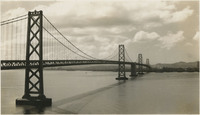 McCarthy Album 11, Photograph 330
 No caption. View of the western, suspension span of the San Francisco-Oakland Bay Bridge, looking toward San Francisco. The photograph was likely taken from a point on either Treasure Island or Yerba Buena Island.
-
McCarthy Album 11, Photograph 329
Image withheld due to copyright considerations. For more information, please contact the California State Archives Reference Desk at ArchivesWeb@sos.ca.gov or (916) 653-2246. Caption: "San Francisco Oakland Bay Bridge, Nov. 12, 1936." View of the western, suspension span of the San Francisco-Oakland Bay Bridge from its deck. A single automobile can be seen traveling away from the photographer.
-
McCarthy Album 11, Photograph 328
Image withheld due to copyright considerations. For more information, please contact the California State Archives Reference Desk at ArchivesWeb@sos.ca.gov or (916) 653-2246. Caption: "San Francisco Oakland Bay Bridge, Nov. 12, 1936." View of the western, suspension span of the San Francisco-Oakland Bay Bridge at dusk.
-
McCarthy Album 11, Photograph 327
Image withheld due to copyright considerations. For more information, please contact the California State Archives Reference Desk at ArchivesWeb@sos.ca.gov or (916) 653-2246. Caption: "The Passing of the Ferry Boat -- San Francisco-Oakland Bay Bridge, Nov. 12, 1936." Shows the western, suspension span of the San Francisco-Oakland Bay Bridge, with three ferries passing underneath it.
-
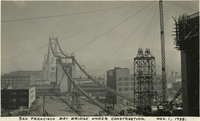 McCarthy Album 11, Photograph 326
 Caption: "San Francisco Bay Bridge Under Construction. Nov. 1, 1935." View of the towers and suspension cables of the western half of the San Francisco-Oakland Bay Bridge, spanning the distance between Yerba Buena Island in San Francisco Bay to the City of San Francisco. The bridge deck has not yet been completed. The Bay Bridge's design combined three different types of bridge-building technology over the five miles it covers between San Francisco and Oakland: a suspension span, a cantilevered span, and a tunnel. At the time of its completion in 1936, the bridge was the longest steel structure on the globe. It also featured the deepest bridge pier ever built, and the world's largest bore tunnel.
-
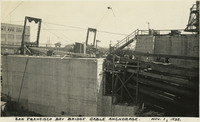 McCarthy Album 11, Photograph 325
 Caption: "San Francisco Bay Bridge Cable Anchorage. Nov. 1, 1935." View of a cable anchorage at one terminus of the San Francisco-Oakland Bay Bridge. The Bay Bridge's design combined three different types of bridge-building technology over the five miles it covers between San Francisco and Oakland: a suspension span, a cantilevered span, and a tunnel. At the time of its completion in 1936 the bridge was the longest steel structure on the globe. It also featured the deepest bridge pier ever built, and the world's largest bore tunnel.
-
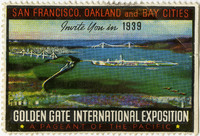 McCarthy Album 11, Photograph 324a
 No caption. Commemorative stamp celebrating the upcoming Golden Gate International Exposition, c. 1938. The Exposition, which ran from February through October in 1939 and May to September in 1940, celebrated the completion of the San Francisco-Oakland Bay Bridge (1936) and the Golden Gate Bridge (1937). More than ten million people attended in 1939, while an additional five million visited in 1940. The Exposition was held on an artificial island created by dredging more than 19 million cubic yards of material from the bottom of the bay. The federal government completed this dredging and fill, intending for the site, called Treasure Island, to become a municipal airport after the exposition. However, the advent of World War II resulted in the U.S. Navy taking over the site, holding it until for military purposes until 1997.
-
McCarthy Album 11, Photograph 324
Image withheld due to copyright considerations. For more information, please contact the California State Archives Reference Desk at ArchivesWeb@sos.ca.gov or (916) 653-2246. Double-sized panoramic postcard entitled "San Francisco-Oakland Bay Bridge, Golden Gate Bridge and Golden Gate International Exposition," c. 1938. Artist's rendering of San Francisco Bay, featuring the Golden Gate Bridge, the San Francisco-Oakland Bay Bridge, and the Golden Gate International Exposition.
-
 McCarthy Album 11, Photograph 323
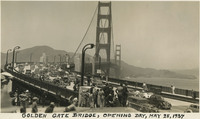
 Caption: "Golden Gate Bridge, Opening Day, May 28, 1937." Dozens of automobiles are visible crossing the Golden Gate Bridge in this photograph, taken on the bridge's Opening Day, the first day that vehicular traffic was allowed over the bridge. Completed in 1937, the Golden Gate Bridge spans the mouth of San Francisco Bay (called the Golden Gate), connecting San Francisco with Marin County to the north. It is one of the most recognizable bridges in the world, and was named in 1994 as one of the Modern Wonders of the World by the American Society of Civil Engineers.
-
 McCarthy Album 11, Photograph 322
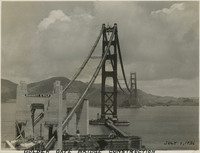
 Caption: "Golden Gate Bridge Construction, July 1, 1936." View of the Golden Gate Bridge while under construction. The towers and suspension cables have been built, but the work on the bridge deck has not started. Completed in 1937, the Golden Gate Bridge spans the mouth of San Francisco Bay (called the Golden Gate), connecting San Francisco with Marin County to the north. It is one of the most recognizable bridges in the world, and was named in 1994 as one of the Modern Wonders of the World by the American Society of Civil Engineers.
-
 McCarthy Album 11, Photograph 321
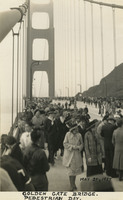
 Caption: "Golden Gate Bridge. Pedestrian Day. May 27, 1937." View of crowds walking across the just-completed Golden Gate Bridge as part of Pedestrian Day. Pedestrian Day kicked off the Golden Gate Bridge Fiesta celebrating the opening of the now-iconic bridge. Approximately 200,000 people walked or roller-skated across the bridge during the Pedestrian Day festivities, held the day before the bridge opened to vehicular traffic.
-
 McCarthy Album 11, Photograph 320b
 No caption. Reverse of a souvenir ticket for the "Official Pedestrian Day" on May 27, 1937, held as part of the Golden Gate Bridge Fiesta celebrating the opening of the now-iconic bridge. The celebrations occupied an entire week, kicked off by Pedestrian Day, when more 200,000 people were allowed to walk across the Golden Gate Bridge on foot or on roller skates, the day before the bridge opened for vehicular traffic.
-
 McCarthy Album 11, Photograph 320a
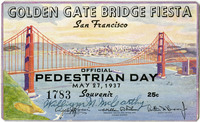
 No caption. Obverse of a souvenir ticket for the "Official Pedestrian Day" on May 27, 1937, held as part of the Golden Gate Bridge Fiesta celebrating the opening of the now-iconic bridge. The celebrations occupied an entire week, kicked off by Pedestrian Day, when more 200,000 people were allowed to walk across the Golden Gate Bridge on foot or on roller skates, the day before the bridge opened for vehicular traffic.
-
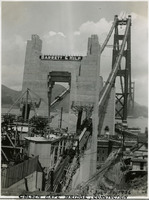 McCarthy Album 11, Photograph 320
 Caption: "Golden Gate Bridge, Construction, July 1, 1936." Image of one terminus of the Golden Gate Bridge, showing the anchoring site of the suspension wires. Completed in 1937, the Golden Gate Bridge spans the mouth of San Francisco Bay (called the Golden Gate), connecting San Francisco with Marin County to the north. It is one of the most recognizable bridges in the world, and was named in 1994 as one of the Modern Wonders of the World by the American Society of Civil Engineers.
-
McCarthy Album 11, Photograph 319
Image withheld due to copyright considerations. For more information, please contact the California State Archives Reference Desk at ArchivesWeb@sos.ca.gov or (916) 653-2246. Caption: "East Bay Span of S.F.-Oakland Bay Bridge, Nov. 12, 1938."
-
McCarthy Album 11, Photograph 318
Image withheld due to copyright considerations. For more information, please contact the California State Archives Reference Desk at ArchivesWeb@sos.ca.gov or (916) 653-2246. Caption: "San Francisco, Down Town and Bay Bridge. Feb. 1, 1938." Postcard showing what appears to be an artist's rendition of downtown San Francisco and the San Francisco-Oakland Bay Bridge.
-
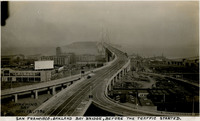 McCarthy Album 11, Photograph 317
 Caption: "Opening Day, Nov. 12, 1936, San Francisco, Oakland Bay Bridge, Before the Traffic Started." View of the San Francisco terminus of the San Francisco-Oakland Bay Bridge. Built between May 1933 and its opening on November 12, 1936, the Bay Bridge's design combined three different types of bridge-building technology over the five miles it covers between San Francisco and Oakland: a suspension span, a cantilevered span, and a tunnel. At the time of its completion the bridge was the longest steel structure on the globe. It also featured the deepest bridge pier ever built, and the world's largest bore tunnel.
-
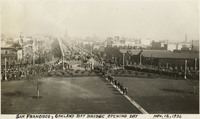 McCarthy Album 11, Photograph 316
 Caption: "San Francisco, Oakland Bay Bridge. Opening Day, Nov. 12, 1936." View of a portion of the ceremonies officially opening the San Francisco-Oakland Bay Bridge to traffic upon its completion in November 1936. The Bay Bridge's design combined three different types of bridge-building technology over the five miles it covers between San Francisco and Oakland: a suspension span, a cantilevered span, and a tunnel. At the time of its completion the bridge was the longest steel structure on the globe. It also featured the deepest bridge pier ever built, and the world's largest bore tunnel.
-
 McCarthy Album 11, Photograph 315
 Caption: "The China Clippers [sic] First Start Across the Pacific Ocean. Nov. 22, 1935." View of the China Clipper, a Martin M-130 four-engine flying boat constructed for Pan American Airways in 1935. One of the largest planes of its time, the China Clipper flew the first transpacific commercial airmail flight between San Francisco and Manila in the Philippines. The China Clipper was destroyed in a crash ten years later, in January 1945, at the Port of Spain, Trinidad and Tobago.