Items
Search full-text
William M. McCarthy Photograph Collection
-
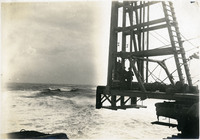 McCarthy Album 02, Photograph 069 No Caption: See also 96-07-08-alb08-145 with caption: "Pile Driver in the Breakers, Columbia River Jetty," c. 1910. View of a large pile driver used in the construction of the jetty system at the mouth of the Columbia River. This is likely at the end of the so-called South Jetty, extending more than six miles into the ocean from Point Adams on the Oregon side of the river mouth. The jetty system at the mouth of the Columbia River was constructed between 1885 and 1917. Designed to funnel water from the Columbia River in a more concentrated fashion into the Pacific Ocean, the jetty system helped create a deeper, more stable shipping channel.
 -
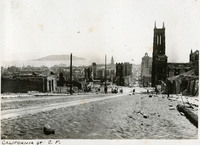 McCarthy Album 03, Photograph 112 Caption: "California St. S.F." Shows the devastation from the 1906 earthquake and fires, along California Street in San Francisco, 1906.
 -
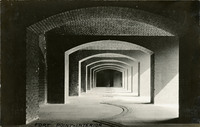 McCarthy Album 08, Photograph 238 Caption: "Fort Point -- Interior," c. 1910. Postcard showing a view of an interior hall or walkway featuring several arches at Fort Point. The facilities at Fort Point were part of an effort by the U.S. government to protect the Golden Gate, entrance to the San Francisco Bay. Built between 1853-1861, the fort included emplacements for 141 guns but never fired a weapon in defense of the Bay. Its name was officially changed in 1882 to Fort Winfield Scott, but in 1886 the fort was officially downgraded to a sub-post of the San Francisco Presidio and the name discontinued. It was resurrected in 1912, with the establishment of a coastal artillery fortification at the Presidio, called, once again, Fort Winfield Scott.
 -
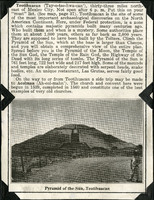 McCarthy Album 10, Photograph 424 No Caption: A section from an informational tourist brochure describing Teotihuacan, an area northeast of Mexico City and famous for some of the most important archaeological discoveries on the North American Continent.
 -
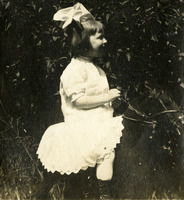 McCarthy Album 05, Photograph 153 No caption, c. 1906. Unidentified girl sitting on rocking horse or hobby horse, in a park or garden.
 -
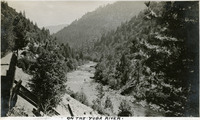 McCarthy Album 06, Photograph 095 Caption: "On the Yuba River," c. 1920, shows an unidentified person standing on the bank of the Yuba River in Nevada County.
 -
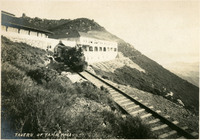 McCarthy Album 06, Photograph 219 Caption: "Tavern of Tamalpais," c. 1907, shows a train leaving the Tamalpais Tavern on Mount Tamalpais in Marin County.
 -
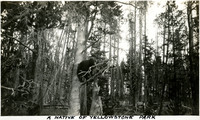 McCarthy Album 09, Photograph 041 Caption: "A Native of Yellowstone Park," c. 1923. A bear climbing a tree in Yellowstone National Park.
 -
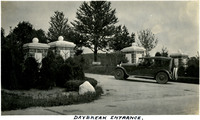 McCarthy Album 09, Photograph 169 Caption: "Daybreak Entrance." A man pauses for a quick photo sitting in his car at the entrance to a private road leading to the Daybreak Estate area of Long Island.
 -
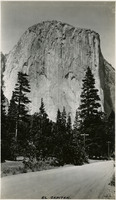 McCarthy Album 09, Photograph 296 Caption: "El Capitan," c. 1917. El Capitan is a vertical granite rock formation in Yosemite Valley. It's sheer cliff face, rising almost 3,000 feet above the Valley, is a favorite rock climbing location.
 -
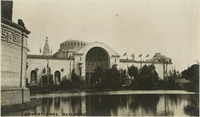 McCarthy Album 07, Photograph 100 Caption: "Educational Building," at the Panama-Pacific International Exposition. See also 96-07-08-alb01-082.
 -
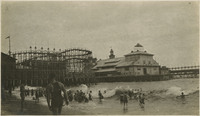 McCarthy Album 07, Photograph 228 No Caption: Scenic railway at Venice beach wharf, c. 1915.
 -
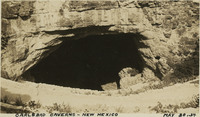 McCarthy Album 11, Photograph 033 Caption: "Carlsbad Caverns -- New Mexico, May 30, 34." View looking into dark cave mouth of Carlsbad Cavern, a series of natural underground chambers including the "Big Room," the fifth-largest such chamber in North America with a length of 1,000 feet, a width of 625 feet, and a maximum height of 255 feet. The site was named Carlsbad Cave National Monument in 1923, and declared Carlsbad Caverns National Park in 1930.
 -
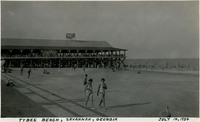 McCarthy Album 11, Photograph 158 Caption: "Tybee Beach, Savannah, Georgia, July 14, 1934." Beach scene with a small crowd of unidentified people enjoying the ocean waves and strolling in the sand. The large Tybrisa Pavilion, set on a wood pier, extends into the water. Tybee Beach is one of several beaches in Tybee Island, a town on an island of the same name located across the river from Savannah. The island became a popular tourist spot between the Civil War and the mid-twentieth century, particularly after the Central of Georgia Railway constructed a line to the island. To encourage tourists, the railroad built Tybrisa Pavilion in 1891. It featured a large dance floor that became popular on the Big Band circuit, but was destroyed by fire in 1967.
 -
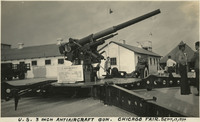 McCarthy Album 11, Photograph 280 Caption: "U.S. 3 Inch Antiaircraft [sic] Gun. Chicago Fair. Sept, [sic] 19, 1934." View of a 3"/50 caliber anti-aircraft gun, a heavy artillery weapon used by the US Navy and Coast Guard. The weapon was part of a display at Chicago's Century of Progress Exposition. The Exposition, a world fair attended by thirty-nine million people, celebrated Chicago's one-hundred year anniversary of incorporation. Originally planned to only run from May to November in 1933, it was such a success that its organizers decided to keep it running for a second season from May through October the following year. The central theme of the Exposition was technological innovation, with a motto of "Science Finds, Industry Applies, Man Conforms."
 -
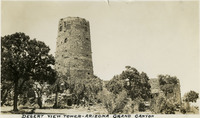 McCarthy Album 10, Photograph 053 Caption: "Desert View Tower - Arizona Grand Canyon," c. 1935. The Desert View Watchtower, built in 1932, was designed by architect Mary Colter in the style of Ancestral Puebloan watchtowers.
 -
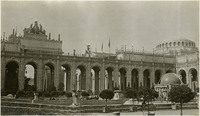 McCarthy Album 01, Photograph 063 No Caption: " Court of Abundance, at the Panama-Pacific International Exposition.
 -
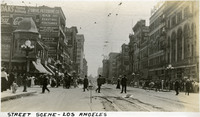 McCarthy Album 05, Photograph 283 Caption: "Street Scene -- Los Angeles," c. 1910. Street-level view of an unidentified busy street in Los Angeles.
 -
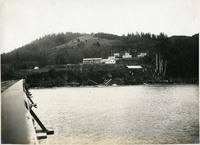 McCarthy Album 02, Photograph 070 No Caption: See also 96-07-08-alb08-140 with caption: "Fort Columbia, Wash." c. 1910. Fort Columbia, built between 1896 and 1904, sits on Chinook Point overlooking the Columbia River. It is part of the Three Fort Harbor Defense System protecting the mouth of the river from enemy incursion or attack (the other forts being Oregon's Fort Stevens and Washington's Fort Canby). Fort Columbia was decomissioned after World War II, and is now the site of a Washington State Park.
 -
 McCarthy Album 03, Photograph 113 Caption: "S.F. Before the Fire," shows the central city of San Francisco before the 1906 earthquake and fires, 1906.
 -
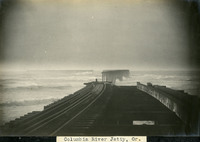 McCarthy Album 08, Photograph 116 Caption: "Columbia River Jetty, Or.," c. 1905. View of a dilapidated jetty that once carried railroad tracks. Portions of the jetty appear to have been destroyed or washed away.
 -
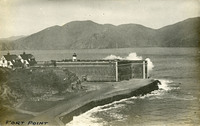 McCarthy Album 08, Photograph 239 Caption: "Fort Point," c. 1910. This postcard shows a view of Fort Point, at the entrance to San Francisco Bay. The facilities at Fort Point were part of an effort by the U.S. government to protect the Golden Gate, entrance to the San Francisco Bay. Built between 1853-1861, the fort included emplacements for 141 guns but never fired a weapon in defense of the Bay. Its name was officially changed in 1882 to Fort Winfield Scott, but in 1886 the fort was officially downgraded to a sub-post of the San Francisco Presidio and the name discontinued. It was resurrected in 1912, with the establishment of a coastal artillery fortification at the Presidio, called, once again, Fort Winfield Scott.
 -
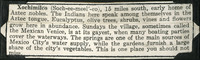 McCarthy Album 10, Photograph 424a No Caption: A section from an informational tourist brochure describing Xochimilco, south of Mexico City, sometimes called the Mexican Venice, for its canals and floating gardens.
 -
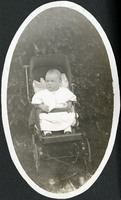 McCarthy Album 05, Photograph 154 No caption, c. 1906. Unidentified baby in stroller, located in a park or garden.
 -
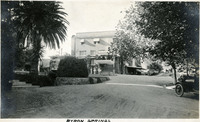 McCarthy Album 06, Photograph 096 Caption: "Byron Springs," c. 1915-1920. Grounds and entrance to the Byron Hot Springs resort hotel, built in 1913 (the third hotel on the site). See also 96-07-08-alb04-155.
 -
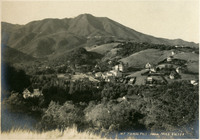 McCarthy Album 06, Photograph 220 Caption: "Mt Tamalpais from Mill Valley," c. 1907 shows a bird's eye view of Mount Tamalpais and the valley below.
 -
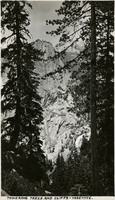 McCarthy Album 09, Photograph 297 Caption: "Towering Trees and Cliffs - Yosemite," c. 1917. View of a granite mountain top as viewed through trees on a neighboring peak.
 -
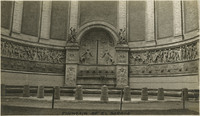 McCarthy Album 07, Photograph 101 Caption: "Fountain of El Dorado," (Gertrude Vanderbilt Whitney, sculptor), at the Panama-Pacific International Exposition. See also 96-07-08-alb01-083.
 -
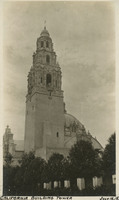 McCarthy Album 07, Photograph 229 Caption: "California Building Tower - July 18, 15," (Bertrum Goodhue, architect), at the Panama-California Exposition in Balboa Park, San Diego, 1915. The exposition's Spanish Colonial Revival style architecture designed by Bertrum Goodhue is credited with giving the style national exposure.
 -
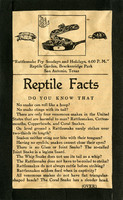 McCarthy Album 11, Photograph 033a One side of a flier handed out by the San Antonio Reptile Garden in the mid-1930s entitled "Reptile Facts." The Reptile Garden opened in the 1930s as a fundraising facility for the Witte Museum. The Garden featured turtle races, snake handling demonstrations, fried rattlesnake meat, and rattlesnake dinner fund raisers. It also became a research center for the use of antivenom. The Garden closed in the early 1940s, its live snakes donated to the San Antonio Zoo.
 -
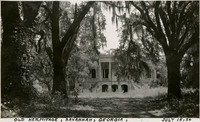 McCarthy Album 11, Photograph 159 Caption: "Old Hermitage, Savannah, Georgia, July 15, 1934." The remains of the Hermitage Plantation mansion, built in 1830, can be seen through trees draped with Spanish moss. Hermitage was a 400-acre plantation on the Savannah River, owned by Henry McAlpin. McAlpin not only conducted farming operations at the planation, but also manufactured bricks, barrels, cast iron products, and lumber.
 -
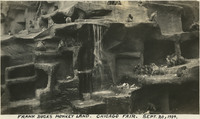 McCarthy Album 11, Photograph 281 Caption: "Frank Bucks [sic] Monkey Land. Chicago Fair. Sept. 20, 1934." View of a rocky cliff populated by a species of monkey. This was part of a display at Frank Buck's Jungle Camp, an exhibition at Chicago's Century of Progress Exposition. The Exposition, a world fair attended by thirty-nine million people, celebrated Chicago's one-hundred year anniversary of incorporation. Originally planned to only run from May to November in 1933, it was such a success that its organizers decided to keep it running for a second season from May through October the following year. The central theme of the Exposition was technological innovation, with a motto of "Science Finds, Industry Applies, Man Conforms."
 -
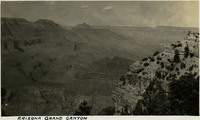 McCarthy Album 10, Photograph 054 Caption: "Arizona Grand Canyon," c. 1935.
 -
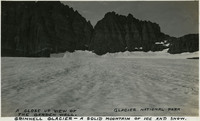 McCarthy Album 10, Photograph 181 Caption: "Grinnell Glacier - A solid mountain of ice and snow. A close up view of the Garden Wall, Glacier National Park," c. 1935.
 -
 McCarthy Album 10, Photograph 307 No Caption: An unidentified group of California Indian women and children standing in front of a wigwam covered in tree bark. A young child in front of the group is dressed in traditional clothing.
 -
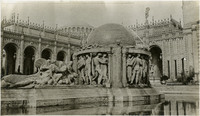 McCarthy Album 01, Photograph 064 No Caption: Fountain of the Earth (Robert I. Aitken, sculptor), in the Court of Abundance at the Panama-Pacific International Exposition.
 -
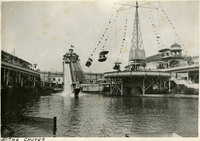 McCarthy Album 03, Photograph 114 Caption: "The Chutes," c, 1907, were an attraction at an amusement park located on 10th and Fulton Streets in San Francisco from 1902 - 1907.
 -
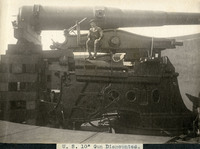 McCarthy Album 08, Photograph 117 Caption: "U.S. 10" Gun Dismounted.," c. 1905. View from the side of a 10" disappearing gun, a heavy coastal artillery weapon. It has been dismounted from its carriage, with one end held up by timbers. An unidentified man is seated near the barrel of the gun.
 -
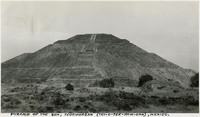 McCarthy Album 10, Photograph 425 Caption: "Pyramid of the Sun, Teotihuacan (Tay-o-tee-haw-can), Mexico."
 -
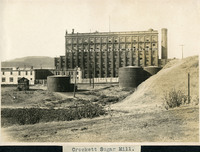 McCarthy Album 06, Photograph 097 Caption: "Crockett Sugar Mill, "c. 1906. The Californian and Hawaiian Sugar Refining Company Building in Crockett, Contra Costa County, California.
 -
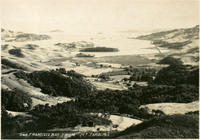 McCarthy Album 06, Photograph 221 Caption: "San Francisco Bay From Mt Tamalpais," c. 1907. A bird's eye view of the bay from atop Mount Tamalpais.
 -
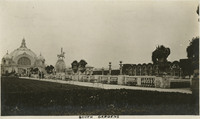 McCarthy Album 07, Photograph 102 Caption: "South Gardens," at the Panama-Pacific International Exposition. See also 96-07-08-alb01-084.
 -
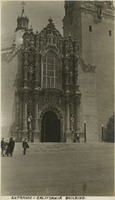 McCarthy Album 07, Photograph 230 Caption: "Entrance - California Building," (Bertrum Goodhue, architect), shows the richly-decorated entranceway to the California Building at the Panama-California Exposition in Balboa Park, San Diego, 1915.
 -
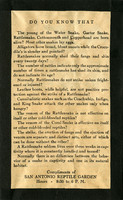 McCarthy Album 11, Photograph 033b One side of a flier handed out by the San Antonio Reptile Garden in the mid-1930s entitled "Reptile Facts." The Reptile Garden opened in the 1930s as a fundraising facility for the Witte Museum. The Garden featured turtle races, snake handling demonstrations, fried rattlesnake meat, and rattlesnake dinner fund raisers. It also became a research center for the use of antivenom. The Garden closed in the early 1940s, its live snakes donated to the San Antonio Zoo.
 -
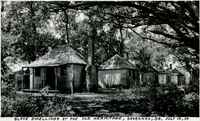 McCarthy Album 11, Photograph 160 Caption: "Slave Dwellings at the Old Hermitage, Savannah, Ga. July 15, 1934." A row of small brick houses surrounded by trees. The Old Hermitage was a 400-acre plantation on the Savannah River, owned by Henry McAlpin. McAlpin not only conducted farming operations at the plantation, but also manufactured bricks, barrels, cast iron products, and lumber. For that reason, he built the slave quarters for the plantation from brick, rather than wood as was common for most other plantations in the South.
 -
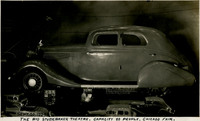 McCarthy Album 11, Photograph 282 Caption: "Sept. 20, 1934, The Big Studebaker Theatre. Capacity 80 People. Chicago Fair." This giant replica of a 1934 Studebaker Land Cruiser at the Century of Progress Exposition, made of plaster over a wood frame, sat above a small theater capable of sitting eighty people. The Exposition, a world fair attended by thirty-nine million people, celebrated Chicago's one-hundred year anniversary of incorporation. Originally planned to only run from May to November in 1933, it was such a success that its organizers decided to keep it running for a second season from May through October the following year. The central theme of the Exposition was technological innovation, with a motto of "Science Finds, Industry Applies, Man Conforms."
 -
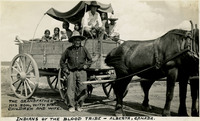 McCarthy Album 10, Photograph 182 Caption: "Indians of the Blood Tribe - Alberta, Canada. The Grandfather, and his son, with six children and wife," c. 1935, shows the Blood Indian family riding in a horse-drawn wagon.
 -
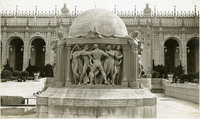 McCarthy Album 01, Photograph 065 No Caption: Fountain of the Earth (Robert I. Aitken, sculptor), in the Court of Abundance, at the Panama-Pacific International Exposition.
 -
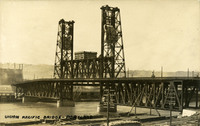 McCarthy Album 05, Photograph 027 Caption: "Union Pacific Bridge -- Portland," c. 1912. Built in 1912, this through-truss, double-deck, vertical lift bridge crosses the Willamette River in Portland, Oregon.
 -
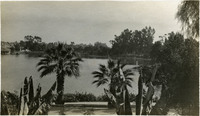 McCarthy Album 05, Photograph 285 No caption, undated. Image of unidentified lake and surrounding park.