Items
Search full-text
William M. McCarthy Photograph Collection
-
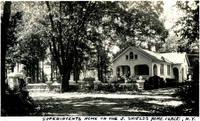 McCarthy Album 09, Photograph 162 Caption: "Superintents [sic] Home On The J. Shields Home. Place. N.Y." A small home on the property of John Shields, on Long Island, secondary to the main residence on the property.
 -
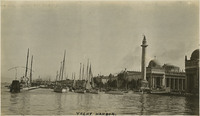 McCarthy Album 07, Photograph 093 Caption: "Yacht Harbor," on the San Francisco Bay outside the Panama-Pacific International Exposition. See also 96-07-08-alb01-075.
 -
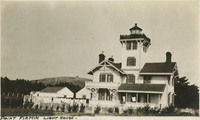 McCarthy Album 07, Photograph 221 Caption: "Point Firmin [sic] Lighthouse," c. 1915, shows the Point Fermin lighthouse, built in 1874 in San Pedro Bay, which was the first navigational light into the bay. It served as a federally-operated lighthouse until 1927, when its operations were turned over to the City of Los Angeles. After the bombing of Pearl Harbor in 1941, the west coast was blacked out for fear of being an easy target to enemy forces. It was never lit again, but during WWII it served the U.S. Navy as a lookout tower and signaling station for ships coming into the San Pedro Bay. In 2003, the lighthouse was opened after being restored, retrofitted, and rehabilitated for public use. It is listed on the National Register of Historic Places and managed by the Department of Recreation and Parks of the City of Los Angeles.
 -
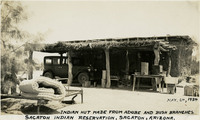 McCarthy Album 11, Photograph 026 Caption: "Indian Hut Made From Adobe and Bush Branches, Sacaton Indian Reservation, Sacaton, Arizona, May, 24, 1934." View of a small adobe building with a porch area across the length of the façade. The porch is sheltered by a low roof supported by tree trunks or thick tree branches and thatched with grass or sticks. Located south of Phoenix and including the town of Sacaton, the Gila River Indian Reservation is home to members of the Akimel O’odham (Pima) and the Pee-Posh (Maricopa) tribes. The reservation was established in 1859. Eighty years later, in 1939, Congress provided for the self-governance of the reservation via the Gila River Indian Community.
 -
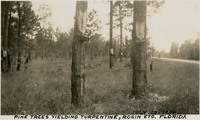 McCarthy Album 11, Photograph 151 Caption: "Pine Trees Yielding Turpentine, Rosin [sic], Etc. Florida, July 13, 1934." A group of pine trees with bark removed in a "V"-shaped, or "catface" pattern to encourage production of resin, from which turpentine is made. Small buckets hang at the end of each "V" to catch the resin. This turpentine farm may actually be in Georgia, rather than Florida.
 -
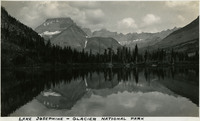 McCarthy Album 10, Photograph 173 Caption: "Lake Josephine-Glacier National Park," c. 1935.
 -
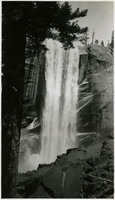 McCarthy Album 10, Photograph 299 No Caption: An unidentified waterfall at Yosemite National Park, c. 1935.
 -
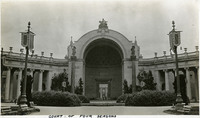 McCarthy Album 01, Photograph 056 Caption: "Court of the Four Seasons," at the Panama-Pacific International Exposition.
 -
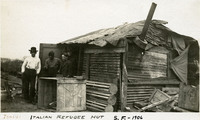 McCarthy Album 05, Photograph 018 Caption: "Italian Refugee Hut S.F. -- 1906." Makeshift hut with four unidentified men standing in doorway. After the earthquake and fire that destroyed much of San Francisco in April 1906, hundreds of thousands of people were left homeless. Many of these people established temporary refugee camps, using debris from the destruction to cobble together shelters.
 -
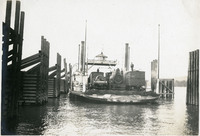 McCarthy Album 02, Photograph 063 No Caption: See also 96-07-08-alb08-114 with caption: "Ferry Boat Tacoma on the Columbia River," Pacific Northwest, c. 1905. View of the railroad ferry Tacoma, with a train on board. The Tacoma operated from 1884 until 1908, when a railroad bridge was constructed across the Columbia River, connecting Portland, Oregon, with points north of the river.
 -
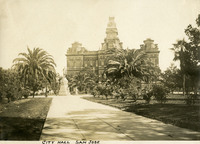 McCarthy Album 03, Photograph 106 Caption: "City Hall San Jose," c. 1905 (Theodore Lenzen, Architect), served as the San Jose City Hall from 1889 until it was demolished and replaced in 1958.
 -
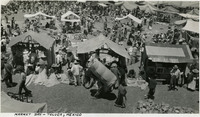 McCarthy Album 10, Photograph 420 Caption: "Market Day - Toluca, Mexico."
 -
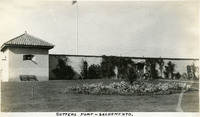 McCarthy Album 06, Photograph 089 Caption: "Sutters [sic] Fort - Sacramento," c. 1920, shows a gun tower at Sutter's Fort, and a gate bracketed by two cannons. John Sutter established the fort in 1839, calling it New Helvetia. After the discovery of gold at one of Sutter's mills (at Coloma, on the American River), almost all of the fort's inhabitants left for the gold fields in the foothills. The fort deteriorated until being restored from 1891-1893. The Native Sons of the Golden West were influential in the restoration. The fort is now the site of a State Historic Park. See also 96-07-08-alb05-117 and 118.
 -
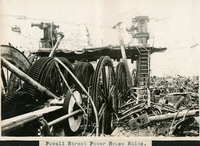 McCarthy Album 06, Photograph 214 Caption: "Powell Street Power House Ruins," shows a view of the Powell Street power house in complete disarray after the 1906 earthquake.
 -
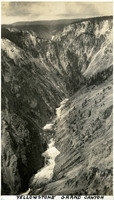 McCarthy Album 09, Photograph 036 Caption: "Yellowstone Grand Canyon," c. 1923. Bird's eye view of the Yellowstone River flowing through the Grand Canyon of the Yellowstone.
 -
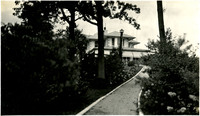 McCarthy Album 09, Photograph 163 No caption: A path leading to the John Shields home on Long Island.
 -
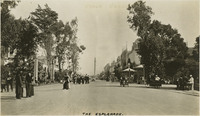 McCarthy Album 07, Photograph 094 Caption: "The Esplanade," at the Panama-Pacific International Exposition. See also 96-07-08-alb01-076.
 -
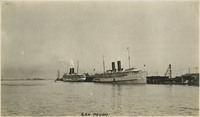 McCarthy Album 07, Photograph 222 Caption: "San Pedro," c. 1915, shows two ships docked at the harbor in San Pedro, Los Angeles.
 -
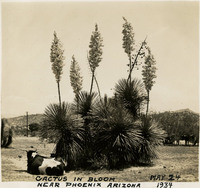 McCarthy Album 11, Photograph 027 Caption: "Cactus in Bloom Near Phoenix Arizona, May 24 1934." Cluster of what appear to be yucca plants in bloom.
 -
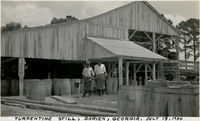 McCarthy Album 11, Photograph 152 Caption: "Turpentine Still, Darien, Georgia. July 13, 1934." Two unidentified men standing in front of a large barn or shed, with numerous barrels surrounding them, presumably for turpentine and other resin products. After being harvested from pine trees, resin is then subjected to steam distillation to evaporate off the turpentine.
 -
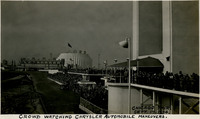 McCarthy Album 11, Photograph 274 Caption: "Crowd Watching Chrysler Automobile Maneuvers. Chicago Fair. Sept. 17, 1934." Fairgoers pack the stands at a demonstration of the capabilities of Chrysler automobiles on a track created as part of the Chrysler complex built for the Exposition. The Exposition, a world fair attended by thirty-nine million people, celebrated Chicago's one-hundred year anniversary of incorporation. Originally planned to only run from May to November in 1933, it was such a success that its organizers decided to keep it running for a second season from May through October the following year. The central theme of the Exposition was technological innovation, with a motto of "Science Finds, Industry Applies, Man Conforms."
 -
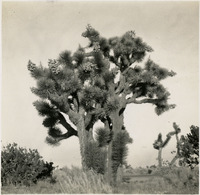 McCarthy Album 10, Photograph 047 No Caption: A Joshua tree in bloom in the Arizona desert, c. 1935.
 -
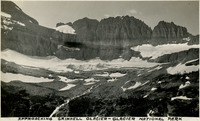 McCarthy Album 10, Photograph 174 Caption: "Approaching Grinnell Glacier - Glacier National Park," c. 1935.
 -
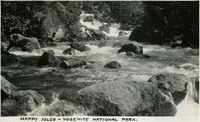 McCarthy Album 10, Photograph 300 Caption: "Happy Isles - Yosemite National Park," c. 1935, shows an unidentified rushing river.
 -
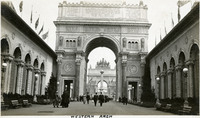 McCarthy Album 01, Photograph 057 Caption: " Western Arch," at the Panama-Pacific International Exposition.
 -
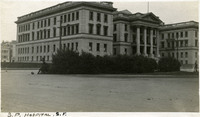 McCarthy Album 05, Photograph 019 Caption: "S.P. Hospital, S.F.," c. 1910. Constructed in 1908 and designed by architect Daniel J. Patterson, the hospital treated Southern Pacific Railroad workers from across the American West, as well as passengers injured while riding. As the twentieth century progressed and automobiles supplanted trains as the premier method of transportation for people and goods, the hospital entered a period of decline, closing in 1974. It has since been renovated and now serves as a senior housing complex.
 -
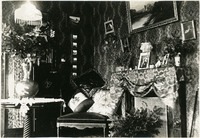 McCarthy Album 02, Photograph 064 No Caption: See also 96-07-08-alb08-053 with caption: "Port Townsend Parlor Scene," Washington, c. 1908.
 -
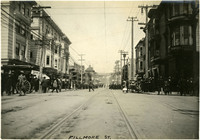 McCarthy Album 03, Photograph 107 Caption: "Fillmore St." Shows a busy Fillmore Street in San Francisco, c. 1907.
 -
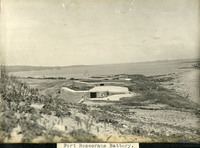 McCarthy Album 08, Photograph 233 Caption: "Fort Rosecrans Battery." View of several coastal defense batteries equipped with heavy artillery guns, at Fort Rosecrans near San Diego.
 -
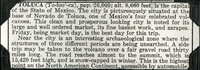 McCarthy Album 10, Photograph 420a No Caption: A section from an informational tourist brochure describing the city of Toluca, the capital of the State of Mexico.
 -
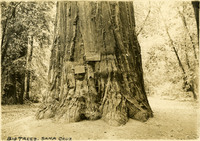 McCarthy Album 05, Photograph 148 Caption: "Big Trees. Sana [sic] Cruz," c. 1905. View of the base of "Gen. Grant," located in the Big Tree Grove near Santa Cruz. See also 96-07-08-alb03-078.
 -
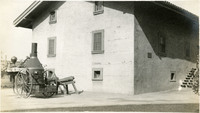 McCarthy Album 06, Photograph 090 No Caption: c. 1920. Image of the main building of Sutter's Fort. John Sutter established the fort in 1839, calling it New Helvetia. After the discovery of gold at one of Sutter's mills (at Coloma, on the American River), almost all of the fort's inhabitants left for the gold fields in the foothills. The fort deteriorated until being restored from 1891-1893. The Native Sons of the Golden West were influential in the restoration. The fort is now the site of a State Historic Park. See also 96-07-08-alb05-117 and 118.
 -
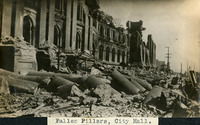 McCarthy Album 06, Photograph 215 Caption: "Fallen Pillars, City Hall," shows the pillars of San Francisco City Hall that fell into the street as a result of the 1906 earthquake.
 -
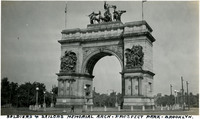 McCarthy Album 09, Photograph 164 Caption: "Soldiers and Sailors Memorial Arch - Prospect Park - Brooklyn," c. 1925. (John H. Duncan, architect) The Soldiers' and Sailors' Arch was built between 1889 and 1892, and dedicated on October 21st, 1892 to honor the "Defenders of the Union, 1861-1865."
 -
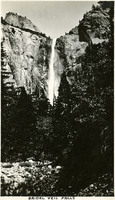 McCarthy Album 09, Photograph 291 Caption: "Bridal Veil Falls [sic]," c. 2017. The 617-foot-tall Bridalveil Fall, one of the iconic natural wonders of Yosemite National Park.
 -
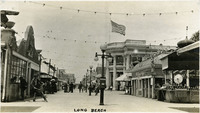 McCarthy Album 07, Photograph 223 Caption: "Long Beach," c. 1915, shows a view of a portion of "The Pike," which was an amusement zone along the shoreline in Long Beach, California. It was founded in 1902 by Charles Rivers Drake, a Civil War veteran and early Long Beach developer. The Pike included arcades, gift shops, food stands, a variety of rides, and a grand bath house (the two-story building pictured on the right). After years of disrepair, The Pike was closed in 1979.
 -
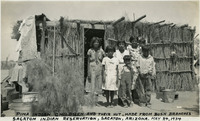 McCarthy Album 11, Photograph 028 Caption: "Pima Indian Children and Their Hut, Made from Bush Branches, Sacaton Indian Reservation, Sacaton, Arizona. May 24, 1934." Several children of the Akimel O'odham (Pima) tribe in front of a hut made with tree branches and wood beams, its walls and roof thatched in brush. Located south of Phoenix and including the town of Sacaton, the Gila River Indian Reservation is home to members of the Akimel O’odham (Pima) and the Pee-Posh (Maricopa) tribes. The reservation was established in 1859. Eighty years later, in 1939, Congress provided for the self-governance of the reservation via the Gila River Indian Community.
 -
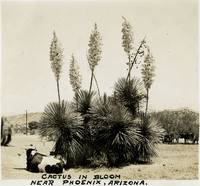 McCarthy Album 10, Photograph 048 Caption: "Cactus in Bloom Near Phoenix, Arizona," c. 1935, shows a large cactus in bloom and a bull resting nearby.
 -
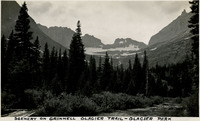 McCarthy Album 10, Photograph 175 Caption: "Scenery on Grinnell Glacier Trail - Glacier Park," c. 1935.
 -
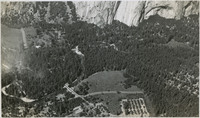 McCarthy Album 10, Photograph 301 No Caption: A birds-eye view of Yosemite Valley with the Merced River running through it, c. 1935.
 -
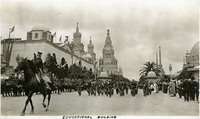 McCarthy Album 01, Photograph 058 Caption: " Educational Building," with marching band and Tower of Jewels in the background at the Panama-Pacific International Exposition.
 -
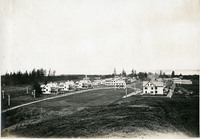 McCarthy Album 02, Photograph 065 No Caption: See also 96-07-08-alb08-139 with caption: "Fort Stevens, Or," c. 1910. A view of buildings at Fort Stevens, part of the Three Fort Harbor Defense System protecting the mouth of the Columbia River from enemy incursion or attack (the other forts being Fort Columbia and Fort Canby, both in Washington). Built during the Civil War, the fort remained active until after World War II. In June 1942, Fort Stevens gained the dubious distinction of being the only military installation in the continental United States to come under enemy fire when a Japanese submarine surfaced off the coast and fired seventeen missiles at the fort. The missiles destroyed the backstop to the fort's baseball field, but otherwise did little harm. Fort Stevens was decommissioned in 1947. It was later turned over to the Oregon Parks and Recreation Department, and currently is the site of an Oregon State Park.
 -
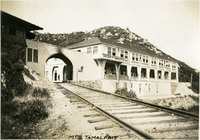 McCarthy Album 03, Photograph 108 Caption: "Mt. Tamalpais." Shows the Muir Woods Railway leading to the Tavern of Tamalpais, Marin County, c. 1907.
 -
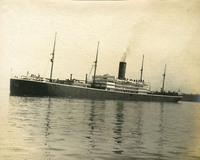 McCarthy Album 08, Photograph 111 Caption: "Steamer Minnesota, Seattle.," c. 1909. View of the steamship Minnesota II, built in 1903. She was said to be the largest U.S. merchant ship afloat at the time. Operated by the Great Northern Steamship Company, she sailed between the U.S. and markets in Asia until 1915. She was sold at that time, and in 1917 began operating in the Atlantic between the U.S. and the United Kingdom. The U.S. Navy commissioned her as a troop ship in 1919, changing her name to Troy. She brought over 14,000 U.S. troops home from war-torn Europe. She never resumed active service after this, being scrapped in 1923. See also 96-07-08-alb08-166.
 -
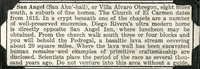 McCarthy Album 10, Photograph 420b No Caption: A section from an informational tourist brochure describing San Angel, or Villa Alvaro Obregon, a municipality of Mexico City.
 -
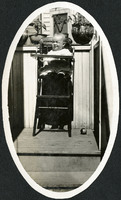 McCarthy Album 05, Photograph 149 No caption, c. 1906. Unidentified baby in high chair.
 -
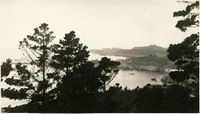 McCarthy Album 06, Photograph 091 No caption, c. 1920. Scene of rocky sea cliffs and ocean, with trees bracketing the view. May be near Midway Point, near Pebble Beach. See also 96-07-08-alb04-217.
 -
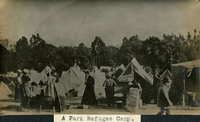 McCarthy Album 06, Photograph 216 Caption: "A Park Refugee Camp," c. 1906. After the earthquake and fire that destroyed much of San Francisco in April 1906, hundreds of thousands of people were left homeless. Many of these people established temporary refugee camps, using tents or debris from the destruction to cobble together shelters.
 -
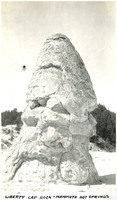 McCarthy Album 09, Photograph 038 Caption: "Liberty Cap Rock - Mammoth Hot Springs," c. 1923. Liberty Cap Rock, a 40-foot tall dormant hot spring cone, is located in the Mammoth Hot Springs area of Yellowstone National Park.
 -
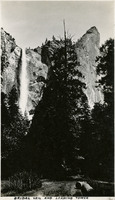 McCarthy Album 09, Photograph 292 Caption: "Bridal Veil [sic] and Leaning Tower," c. 1917. Bridalveil Fall and the adjacent Leaning Tower, a popular rock climbing destination within Yosemite National Park.