Items
Search full-text
William M. McCarthy Photograph Collection
-
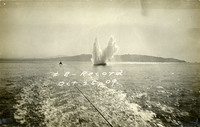 McCarthy Album 05, Photograph 321 Caption: "#2 -- Record Oct 25, 09." This postcard shows plume of seawater thrown up by a mortar shell during target practice at Fort Point. The facilities at Fort Point were part of an effort by the U.S. government to protect the Golden Gate, entrance to the San Francisco Bay. Built between 1853-1861, the fort included emplacements for 141 guns but never fired a weapon in defense of the Bay. Its name was officially changed in 1882 to Fort Winfield Scott. This only lasted four years, however, for in 1886 the fort was officially downgraded to a sub-post of the San Francisco Presidio and the name discontinued. It was resurrected in 1912, however, with the establishment of a coastal artillery fortification at the Presidio, called, once again, Fort Winfield Scott.
 -
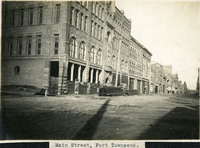 McCarthy Album 08, Photograph 027 Caption: "Main Street, Port Townsend.," c. 1908-1912. Street scene in Washington's Port Townsend, on the tip of the Olympic Peninsula on the shores of Puget Sound.
 -
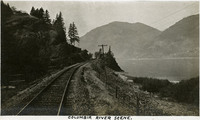 McCarthy Album 05, Photograph 192 Caption: "Columbia River Scene," c. 1910. Train tracks running into the distance with the Columbia River to the right.
 -
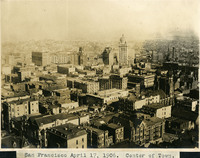 McCarthy Album 06, Photograph 008 Caption: "San Francisco April 17, 1906. Center of Town," shows a view of the center of San Francisco from a high vantage point, taken on April 17, 1906, the day before the 1906 earthquake and fires devastated the city.
 -
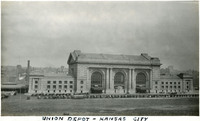 McCarthy Album 09, Photograph 080 Caption: "Union Depot - Kansas City," c. 1923. This Beaux Arts-style rail station opened in 1914, replacing a small depot from 1871. Decreasing rail passenger traffic after World War II resulted in the closure of the depot in 1985. However, the restored depot later reopened in 1999, containing museums and other attractions. In 2002, it was again put to service as a rail depot when Amtrak again brought passenger trains to the area.
 -
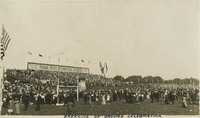 McCarthy Album 07, Photograph 012 Caption: "Breaking of Ground Celebration," Oct 14, 1911, held in San Francisco for the planned Panama-Pacific International Exposition, which was slated to open in 1915. The Panama Pacific International Exposition was held to celebrate the completion of the Panama Canal, as well as inventive technologies and new industries from around the world. It was also a chance for San Francisco to show the world how the great city had rebuilt and thrived after the devastation of the 1906 earthquake and fire.
 -
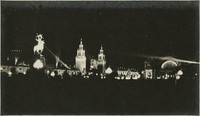 McCarthy Album 07, Photograph 139 No Caption: shows the South Gardens at night at the Panama-Pacific International Exposition. See also 96-07-08-alb01-117, with caption: "South Gardens-Night."
 -
 McCarthy Album 11, Photograph 070 Caption: "Mrs Eliza Smarts Home and Kin -- Chattahoochee, Florida, June 22, 34." Eliza Smart (standing, on the left), two unidentified women, and nine children posing on the porch of a house with wood siding. This is one of the few photographs in which the McCarthys identified some of the people who they met along their travels.
 -
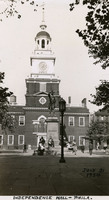 McCarthy Album 11, Photograph 196 Caption: "Independence Hall -- Phila. July 31, 1934." A view of the steeple and bell tower of Independence Hall in Philadelphia, site of the debate over and signing of both the Declaration of Independence and the U.S. Constitution. Completed in 1753 for the use of the Pennsylvania Province's colonial legislature, it was also the site of a 1915 convention marking the formation of the League to Enforce Peace, predecessor entity to the United Nations. The Georgian-style building, designed by Edmund Woolley and Andrew Hamilton, has undergone several renovations. Only the central portion of the building is original -- all other portions of the building have been rebuilt at some point in its past. This building also housed the Liberty Bell until 1976, when the bell was moved to the Liberty Bell Center across the street.
 -
McCarthy Album 11, Photograph 318 Image withheld due to copyright considerations. For more information, please contact the California State Archives Reference Desk at ArchivesWeb@sos.ca.gov or (916) 653-2246. Caption: "San Francisco, Down Town and Bay Bridge. Feb. 1, 1938." Postcard showing what appears to be an artist's rendition of downtown San Francisco and the San Francisco-Oakland Bay Bridge.
-
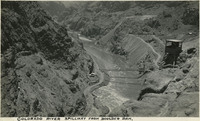 McCarthy Album 10, Photograph 091 Caption: "Colorado River Spillway From Boulder Dam," c. 1935.
 -
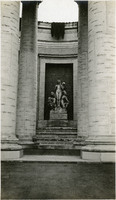 McCarthy Album 01, Photograph 102 No Caption: Fountain of Winter (Furio Piccirilli, sculptor), in the Court of the Four Seasons at the Panama-Pacific International Exposition.
 -
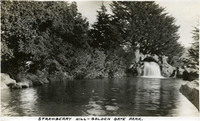 McCarthy Album 05, Photograph 064 Caption: "Strawberry Hill -- Golden Gate Park.," c. 1912-1915. Image of small waterfall and pond on Strawberry Hill. This hill rises above Golden Gate Park in San Francisco, surrounded by the man-made Stow Lake.
 -
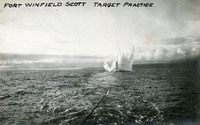 McCarthy Album 05, Photograph 322 Caption: "Fort Winfield Scott Target Practice." This postcard shows a plume of seawater thrown up by a mortar shell during target practice at Fort Point. Fort Point was part of an effort by the U.S. government to protect the Golden Gate, entrance to the San Francisco Bay. Built between 1853-1861, the fort included emplacements for 141 guns but never fired a weapon in defense of the Bay. Its name was officially changed in 1882 to Fort Winfield Scott. This only lasted four years, however, for in 1886 the fort was officially downgraded to a sub-post of the San Francisco Presidio and the name discontinued. It was resurrected in 1912, with the establishment of a coastal artillery fortification at the Presidio, called, once again, Fort Winfield Scott. See also 96-07-08-alb08-029.
 -
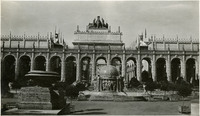 McCarthy Album 03, Photograph 024 No Caption: Court of Abundance at the Panama-Pacific International Exposition, 1915.
 -
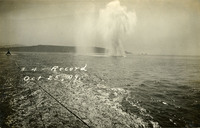 McCarthy Album 08, Photograph 028 Caption: "#4 -- Record Oct 25, 09." This postcard shows plume of seawater thrown up by a mortar shell during target practice at Fort Point. The facilities at Fort Point were part of an effort by the U.S. government to protect the Golden Gate, entrance to the San Francisco Bay. Built between 1853-1861, the fort included emplacements for 141 guns but never fired a weapon in defense of the Bay. Its name was officially changed in 1882 to Fort Winfield Scott, but in 1886 the fort was officially downgraded to a sub-post of the San Francisco Presidio and the name discontinued. It was resurrected in 1912, with the establishment of a coastal artillery fortification at the Presidio, called, once again, Fort Winfield Scott.
 -
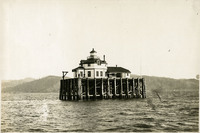 McCarthy Album 08, Photograph 152 No Caption: c. 1910. View of the Desdemona Lighthouse, constructed in 1901 or 1902 on wood pilings over a group of shoals at the mouth of the Columbia River. The shoals carry the same name as the lighthouse, both of which are named for the bark Desdemona which ran aground and was destroyed by the shoals in 1857. The lighthouse was automated in 1934, and its light eventually removed in 1965.
 -
McCarthy Album 11, Photograph 319 Image withheld due to copyright considerations. For more information, please contact the California State Archives Reference Desk at ArchivesWeb@sos.ca.gov or (916) 653-2246. Caption: "East Bay Span of S.F.-Oakland Bay Bridge, Nov. 12, 1938."
-
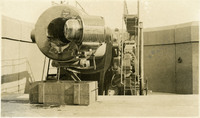 McCarthy Album 05, Photograph 193 No caption, c. 1915. Twelve-inch disappearing coastal defense gun, showing the breech of the barrel where shells are loaded and ejected. Retracting or disappearing guns were a form of artillery developed in the nineteenth century in which heavy artillery guns were placed on rotating carriages that allowed retraction of the weapon after firing, to enable reloading while under enemy fire.
 -
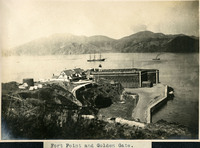 McCarthy Album 06, Photograph 009 Caption: "Fort Point and Golden Gate," c. 1906. Fort Point in the foreground, with ships in the bay. Fort Point was part of an effort by the U.S. government to protect the Golden Gate, entrance to the San Francisco Bay. Built between 1853-1861 of brick and mortar, the fort included emplacements for 141 guns but never fired a weapon in defense of the Bay.
 -
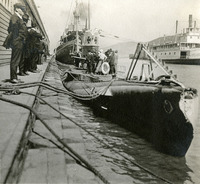 McCarthy Album 06, Photograph 259 No caption. See also 96-07-08-alb05-320, with caption: "Damaged German Submarine.," c. 1917. Shows the above-water portions of a German U-boat, or submarine, likely docked in either Petaluma or San Francisco, given the presence of a Petaluma and Santa Rosa Railway ferry in the background. Unidentified group of men standing on what appears to be a submarine.
 -
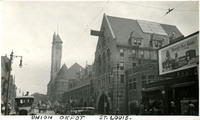 McCarthy Album 09, Photograph 081 Caption: "Union Depot St. Louis," c. 1923. Opened in 1894, the St. Louis Union Depot was designated a National Historic Landmark in 1970. Designed by Theodore Link, the building features a 280-foot-tall clock tower. At the time of its construction, it was the largest, busiest railroad station in the world.
 -
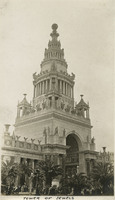 McCarthy Album 07, Photograph 013 Caption: "Tower of Jewels," at the Panama-Pacific International Exposition. The Panama Pacific International Exposition was held to celebrate the completion of the Panama Canal, as well as inventive technologies and new industries from around the world. It was also a chance for San Francisco to show the world how the great city had rebuilt and thrived after the devastation of the 1906 earthquake and fire.
 -
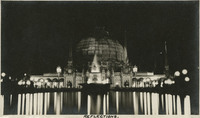 McCarthy Album 07, Photograph 140 Caption: "Reflections," at night shows reflections of lighted buildings in reflecting pool at the Panama-Pacific International Exposition. See also 96-07-08-alb01-112.
 -
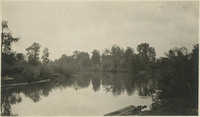 McCarthy Album 07, Photograph 268 No Caption: A view of the Russian River at Healdsburg in Sonoma County, California, c. 1914.
 -
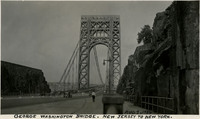 McCarthy Album 11, Photograph 197 Caption: "George Washington Bridge. New Jersey to New York. Aug 1, 1934." This suspension bridge, designed by Othmar Ammann, spans the Hudson River between Manhattan in New York City, and Fort Lee, New Jersey. Constructed between 1927 and 1931, the bridge included the longest main span in the world at the time, a record it held until construction of the Golden Gate Bridge was completed in 1937. It was originally built with only one deck, but a second deck opened in 1962. Still in active use today, it carried over 51 million vehicles in 2016.
 -
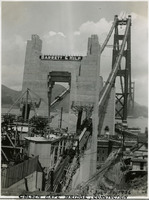 McCarthy Album 11, Photograph 320 Caption: "Golden Gate Bridge, Construction, July 1, 1936." Image of one terminus of the Golden Gate Bridge, showing the anchoring site of the suspension wires. Completed in 1937, the Golden Gate Bridge spans the mouth of San Francisco Bay (called the Golden Gate), connecting San Francisco with Marin County to the north. It is one of the most recognizable bridges in the world, and was named in 1994 as one of the Modern Wonders of the World by the American Society of Civil Engineers.
 -
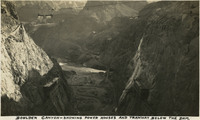 McCarthy Album 10, Photograph 092 Caption: "Boulder Canyon - Showing Power Houses and Tramway Below the Dam," c. 1935. Boulder Canyon, on the Colorado River, is located above Boulder/Hoover Dam and is now flooded by Lake Mead.
 -
 McCarthy Album 10, Photograph 218a No Caption: A "Follow the Birds to Victoria, B.C." sticker, c. 1935.
 -
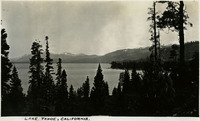 McCarthy Album 10, Photograph 346 Caption: "Lake Tahoe, California," c. 1935.
 -
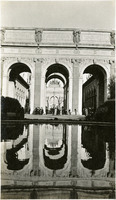 McCarthy Album 01, Photograph 103 No Caption: Scene of archways and reflecting pool at the Panama-Pacific International Exposition.
 -
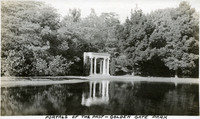 McCarthy Album 05, Photograph 065 Caption: "Portals of the Past," c. 1915. A monument in Golden Gate Park in San Francisco, on the shores of Lloyd Lake, consisting of a white marble archway and columns. The archway was originally part of the Nob Hill mansion belonging to railroad tycoon Alban Towne. The mansion was destroyed in the 1906 San Francisco earthquake and fire, but the entryway still stood. It was moved to the shore of Lloyd Lake in 1909, as a memorial to the pre-1906 city.
 -
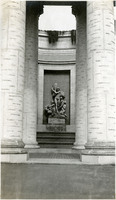 McCarthy Album 03, Photograph 025 No Caption: Fountain of Autumn (Furio Piccirilli, sculptor), in the Court of the Four Seasons at the Panama-Pacific International Exposition, 1915.
 -
 McCarthy Album 08, Photograph 029 Caption: "Target Practice," c. 1908. This postcard shows a plume of seawater thrown up by a mortar shell during target practice at Fort Point. The facilities at Fort Point were part of an effort by the U.S. government to protect the Golden Gate, entrance to the San Francisco Bay. Built between 1853-1861, the fort included emplacements for 141 guns but never fired a weapon in defense of the Bay. Its name was officially changed in 1882 to Fort Winfield Scott, but in 1886 the fort was officially downgraded to a sub-post of the San Francisco Presidio and the name discontinued. It was resurrected in 1912, with the establishment of a coastal artillery fortification at the Presidio, called, once again, Fort Winfield Scott. See also 96-07-08-alb05-322.
 -
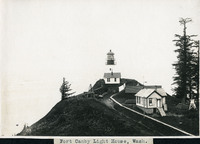 McCarthy Album 08, Photograph 153 Caption: "Fort Canby Lighthouse, Wash.," c. 1910. View of the Cape Disappointment Lighthouse on a rocky point overlooking the mouth of the Columbia River. Cannons and cannon balls are stored on the lighthouse property. Built in the 1850s, the lighthouse was electrified in 1934 and automated in 1973. The lighthouse is now part of the Cape Disappointment State Park (formerly Fort Canby State Park).
 -
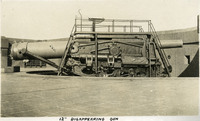 McCarthy Album 05, Photograph 194 Caption: "12" Disappearing Gun," c. 1915. Side view of a coastal defense gun. Retracting or disappearing guns were a form of artillery developed in the nineteenth century in which heavy artillery guns were placed on rotating carriages that allowed retraction of the weapon after firing, to enable reloading while under enemy fire.
 -
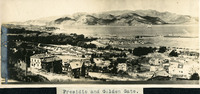 McCarthy Album 06, Photograph 010 Caption: "Presidio and Golden Gate," c. 1906, shows many Presidio buildings pictured in the foreground, with ships in the bay. Established in 1776 by Spanish explorers, the Presidio is a fortified location overlooking the Golden Gate, the entrance into San Francisco Bay. It was closed as a military structure in 1995, and is now a park within the Golden Gate National Recreation Area.
 -
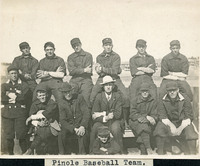 McCarthy Album 06, Photograph 134 Caption: "Pinole Baseball Team," c. 1908.
 -
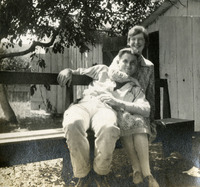 McCarthy Album 06, Photograph 260 No caption. An unidentified man and woman sitting on a bench near the Russian River, c. 1920. See also 96-07-08-alb04-227 and 228.
 -
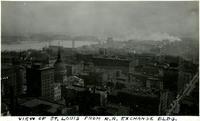 McCarthy Album 09, Photograph 082 Caption: "View of St. Louis from R.R. Exchange Bldg," c. 1923. Merchant's Bridge and the Old Courthouse (domed building just to left of center) can be seen in this bird's eye view of St. Louis.
 -
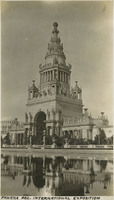 McCarthy Album 07, Photograph 014 Caption: "Panama Pac. International Exposition." A view of the Tower of Jewels with reflecting pool at the Panama-Pacific International Exposition.
 -
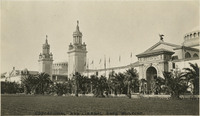 McCarthy Album 07, Photograph 141 Caption: "Educational and Liberal Arts Building," at the Panama-Pacific International Exposition. See also 96-07-08-alb01-119.
 -
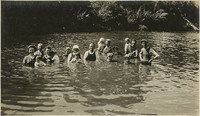 McCarthy Album 07, Photograph 269 No Caption: A group of people shown swimming and wading in the Russian River at Healdsburg in Sonoma County, c. 1914.
 -
 McCarthy Album 11, Photograph 072 Caption: "Monroe St. Tallahassee -- Florida, June 23 1934." Street scene, showing Tallahassee's Monroe Street. Trees and residences line the roadway, with Spanish moss dripping from some of the trees.
 -
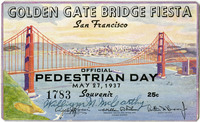 McCarthy Album 11, Photograph 320a No caption. Obverse of a souvenir ticket for the "Official Pedestrian Day" on May 27, 1937, held as part of the Golden Gate Bridge Fiesta celebrating the opening of the now-iconic bridge. The celebrations occupied an entire week, kicked off by Pedestrian Day, when more 200,000 people were allowed to walk across the Golden Gate Bridge on foot or on roller skates, the day before the bridge opened for vehicular traffic.
 -
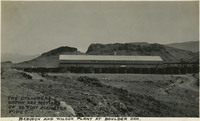 McCarthy Album 10, Photograph 093 Caption: "Babcock and Wilcox Plant at Boulder Dam. The cylinders shown are sections of 30 foot diameter pipe," c. 1935.
 -
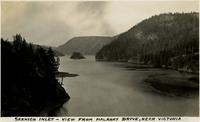 McCarthy Album 10, Photograph 219 Caption: "Saanich Inlet- View from Malahat Drive, near Victoria," c. 1935.
 -
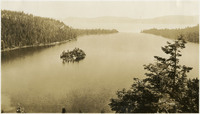 McCarthy Album 10, Photograph 347 No Caption: A view of Emerald Bay at Lake Tahoe, c. 1935.
 -
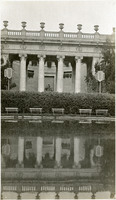 McCarthy Album 01, Photograph 104 No Caption: Building and reflecting pool at the Panama- Pacific International Exposition.
 -
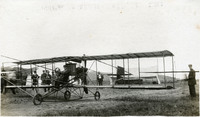 McCarthy Album 05, Photograph 066 No caption, c. 1912-1915. Shows a Curtiss Pusher Model D Biplane, an early biplane with one seat, open to the elements. The "pusher" designation indicates that the propeller is seated behind the engine.