Items
Search full-text
William M. McCarthy Photograph Collection
-
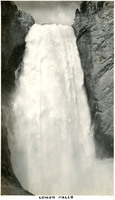 McCarthy Album 09, Photograph 033 Caption: "Lower Falls," c. 1923. As the Yellowstone River flows north from Yellowstone Lake it passes over two waterfalls (Upper and Lower Yellowstone Falls) before reaching the Yellowstone Grand Canyon. This photograph shows the 308-foot Lower Yellowstone Falls, as viewed from the base of the falls. It carries more water volume than any other waterfall in the Rocky Mountains.
 -
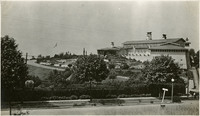 McCarthy Album 04, Photograph 088 No caption, c. 1920. Shows large unidentified building with terraced gardens and a flag pole.
 -
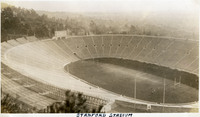 McCarthy Album 04, Photograph 216 Caption: "Stanford Stadium," c. 1921. Birdseye view of the Stanford Stadium, which opened in 1921. This stadium has since been replaced by a more modern facility built in 2005-2006.
 -
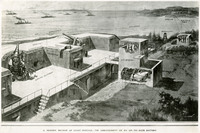 McCarthy Album 08, Photograph 230 No Caption: Photograph of part of a print from the Illustrated London News, titled "A Modern Method of Coast Defense: The Arrangement of an Up-To-Date Battery." See also 96-07-08-alb05-094.
 -
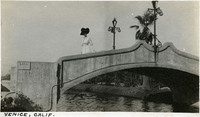 McCarthy Album 05, Photograph 274 Caption: "Venice, Calif," c. 1911. Unidentified woman standing on a bridge over Lion Canal in Venice, California. In 1905, Abbot Kinney built a series of canals as part of a development project along Santa Monica Beach, hoping to recreate the look and feel of Italy's iconic "Floating City" in southern California. Called Ocean Park at first, gondoliers sailed boats under elegant bridges such as the one shown in this photograph, in an effort to attract businesses, residents, and investors. In 1911, the name officially changed to Venice. By 1929, however, many of the canals had been filled in to create roadways, and those canals that remained fell into disrepair. A revitalization movement in the early 1990s has restored some of the canals, and made the area a desirable residential neighborhood.
 -
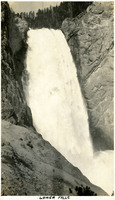 McCarthy Album 09, Photograph 034 Caption: "Lower Falls," c. 1923. As the Yellowstone River flows north from Yellowstone Lake it passes over two waterfalls (Upper and Lower Yellowstone Falls) before reaching the Yellowstone Grand Canyon. This photograph shows the 308-foot Lower Yellowstone Falls. It carries more water volume than any other waterfall in the Rocky Mountains.
 -
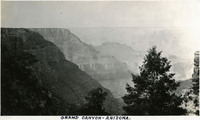 McCarthy Album 04, Photograph 089 Caption: "Grand Canyon -- Arizona.," c. 1920.
 -
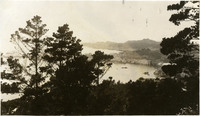 McCarthy Album 04, Photograph 217 No caption, c. 1920. Scene of rocky sea cliffs and ocean, with trees bracketing the view. May be near Midway Point, near Pebble Beach.
 -
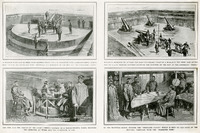 McCarthy Album 08, Photograph 231 No Caption: Photograph of part of a print from the Illustrated London News, regarding placement and operation of coastal artillery defense methods. See also 96-07-08-alb05-095.
 -
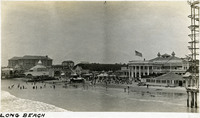 McCarthy Album 05, Photograph 275 Caption: "Long Beach," c. 1910. View of The Pike, an amusement zone along the beach front in Long Beach. The framework for the Bisby's Spiral Airship ride can be seen at the far right of the photograph.
 -
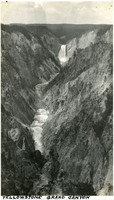 McCarthy Album 09, Photograph 035 Caption: "Yellowstone Grand Canyon," c. 1923. Bird's eye view of the Grand Canyon of the Yellowstone. The 308-foot tall cascade of Lower Yellowstone Falls of the Yellowstone River can be seen at the top of the photograph, flowing into the Canyon. The Canyon is approximately 24 miles long, and between 800 and 1,200 feet deep.
 -
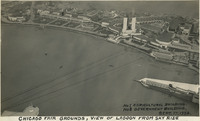 McCarthy Album 11, Photograph 273 Caption: "Chicago Fair Grounds, View of Lagoon from Sky Ride. No 1 Agricultural Building. No2 Government Building. Sept. 17, 1934." Bird's eye view of a portion of the fair grounds for Chicago's Century of Progress Exposition. Two of the fair's structures have been labeled in this photograph, including the Agriculture Building, a long low structure, and the Federal Building, featuring three towers representing the three branches of the federal government. The Exposition, a world fair attended by thirty-nine million people, celebrated Chicago's one-hundred year anniversary of incorporation. Originally planned to only run from May to November in 1933, it was such a success that its organizers decided to keep it running for a second season from May through October the following year. The central theme of the Exposition was technological innovation, with a motto of "Science Finds, Industry Applies, Man Conforms." None of the buildings constructed for the fair are still extant today, having been built as temporary facilities.
 -
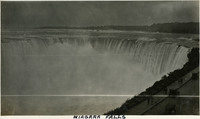 McCarthy Album 04, Photograph 090 Caption: "Niagara Falls," c. 1920. View from southwestern edge of falls. The iconic Niagara Falls straddles the border between Ontario, Canada, and the State of New York.
 -
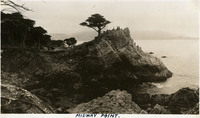 McCarthy Album 04, Photograph 218 Caption: "Midway Point.," c. 1920. Now-iconic image of a rocky outcropping near Pebble Beach, extending into the Pacific Ocean, with a single cypress tree near the top. This tree, sometimes referred to as the "Lone Cypress," has been photographed extensively over the past century. This tree and outcropping can still be seen as part of the 17-Mile Drive, a scenic road tour of the Pebble Beach Resort area in Monterey County.
 -
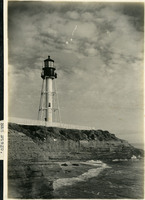 McCarthy Album 08, Photograph 232 Caption: "San Diego." View of Point Loma Light. First lit in 1891, this light replaced the "Old Point Loma Lighthouse" that had been constructed in 1855 (see 96-07-08-alb08-225). The old lighthouse was often obscured by fog, so a new lighthouse was built at a lower elevation much closer to sea level, as can be seen in this photograph. The light was automated in 1973. See also 96-07-08-alb05-226.
 -
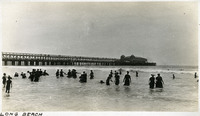 McCarthy Album 05, Photograph 276 Caption: "Long Beach," c. 1910. Bathers enjoying the surf at Long Beach. Long Beach pier runs through the center of the photograph.
 -
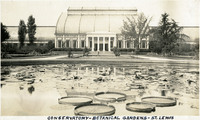 McCarthy Album 04, Photograph 091 Caption: "Conservatory -- Botanical Gardens -- St. Lewis," c. 1923. Shows the Palm House, built in 1915 to house tropical plants in the Missouri Botanical Gardens in St. Louis. It was torn down in 1959 to make room for the domed geodesic Climatron building which still stands at the site. See also 96-07-08-alb09- 086.
 -
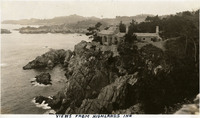 McCarthy Album 04, Photograph 219 Caption: "Views from Highlands Inn," c. 1920. View of the D.L. James House, designed by Charles Greene and built in 1918. The picturesque stone house sits atop a rocky cliff overlooking the Pacific Ocean, a few miles south of Carmel-by-the-Sea.
 -
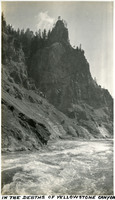 McCarthy Album 09, Photograph 037 Caption: "In the Debths [sic] of Yellowstone Canyon," c. 1923. The Yellowstone River tumbles its way through the Grand Canyon of the Yellowstone in this photograph, taken at river-level.
 -
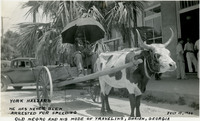 McCarthy Album 11, Photograph 153 Caption: "York Hazzard. He has Never Been Arrested for Speeding. Old Negro and His Mode of Traveling, Darien, Ga. July 13, 1934." York Hazzard, an elderly man of African-American ethnicity, seated in a small wooden cart drawn by a cow or steer. In this photograph Hazzard is sheltered from the sun by an umbrella. An automobile is parked on the street behind the cart.
 -
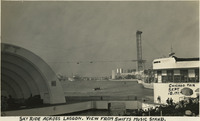 McCarthy Album 11, Photograph 275 Caption: "Sky Ride Across Lagoon. View from Swifts Music Stand. Chicago Fair, Sept. 18, 1934." One of the 628-foot towers making up the Sky Ride, an aerial tramway which carried fair goers in small gondolas or trams (visible in the center of the photograph) over the harbor around which the Century of Progress Exposition was held. Over 4.5 million passengers enjoyed the views from the Sky Ride before it was demolished after the conclusion of the exposition in 1934. The Exposition, a world fair attended by thirty-nine million people, celebrated Chicago's one-hundred year anniversary of incorporation. Originally planned to only run from May to November in 1933, it was such a success that its organizers decided to keep it running for a second season from May through October the following year. The central theme of the Exposition was technological innovation, with a motto of "Science Finds, Industry Applies, Man Conforms."
 -
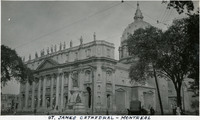 McCarthy Album 04, Photograph 092 Caption: "St. James Cathedral -- Montreal," c. 1925. The St. James Cathedral in Montreal was consecrated in 1894. At that time, it was the largest church in Quebec. Pope Pious XII rededicated the church in 1955 to Mary, Queen of the World. See also 96-07-08-alb09-129.
 -
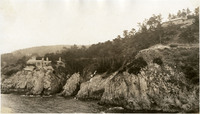 McCarthy Album 04, Photograph 220 No caption, c. 1920. View of rocky cliffs with D.L. James House (designed by Charles Greene and built in 1918) on the left side of the image.
 -
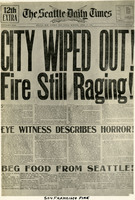 McCarthy Album 05, Photograph 020 Caption: "San Francisco Fire." Photograph of the front page of the Seattle Daily Times, April 20, 1906, in regard to the earthquake and fire that destroyed much of San Francisco on April 18, 1906. The primary headline reads "CITY WIPED OUT! Fire Still Raging!" See also 96-07-08-alb08-186.
 -
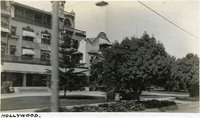 McCarthy Album 05, Photograph 278 Caption: "Hollywood.," c. 1915. Street scene in Hollywood, California. The Hotel Hollywood is visible at the left side of the photograph. The hotel, originally built in 1902 and expanded in 1905, served as a social venue for many of Hollywood's early film stars. It was torn down in 1956 to make way for an office building.
 -
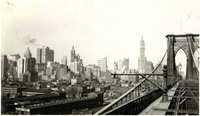 McCarthy Album 09, Photograph 165 No caption: View of New York City's skyline, as seen from the Brooklyn Bridge, c. 1925. A portion of the bridge (designed by architect John Augustus Roebling and completed in 1883) can be seen in the right hand side of the photograph. See also 96-07-08-alb09-144.
 -
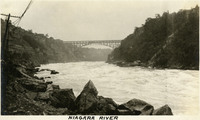 McCarthy Album 04, Photograph 093 Caption: "Niagara River," c. 1920. View of river and bridge.
 -
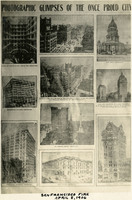 McCarthy Album 05, Photograph 021 Caption: "San Francisco Fire April 8 [sic], 1906." Photograph of a page from the Seattle Daily Times. The headline reads "Photographic Glimpses of the Once Proud City." Several photographs of significant buildings in San Francisco are shown (such as the City Hall), all of which are listed as having been destroyed by the earthquake and fire of April 6th.
 -
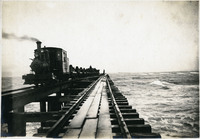 McCarthy Album 02, Photograph 066 No Caption: See also 97-07-08-alb08-143 with caption: "Columbia River Jetty, Or.," c. 1910. View of a jetty built at the mouth of the Columbia River, carrying a railroad trestle. A train hauling cars loaded with large rocks is visible at the left side of the photograph. This is likely the so-called South Jetty, extending more than six miles into the ocean from Point Adams on the Oregon side of the river mouth. The jetty system at the mouth of the Columbia River was constructed between 1885 and 1917. Designed to funnel water from the Columbia River in a more concentrated fashion into the Pacific Ocean, the jetty system helped create a deeper, more stable shipping channel.
 -
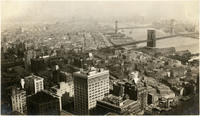 McCarthy Album 09, Photograph 166 No caption: Bird's eye view of New York City's Lower East Side and Two Bridges areas. The Brooklyn and Manhattan bridges span the East River in the right side of the photograph. See also 96-07-08-alb09-145.
 -
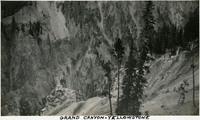 McCarthy Album 04, Photograph 094 Caption: "Grand canyon -- Yellowstone," c. 1920s. View looking down into canyon, featuring steep terrain. The Yellowstone River can be seen at the lower left.
 -
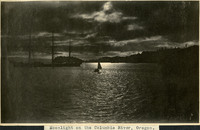 McCarthy Album 08, Photograph 113 Caption: "Moonlight on the Columbia River, Oregon.," c. 1905. Photograph of the Columbia River at night. A cloudy sky nearly obscures the moon, but allows enough light to see a three-masted schooner and a small sailboat on the river.
 -
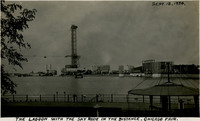 McCarthy Album 11, Photograph 278 Caption: "The Lagoon with the Sky Ride in the distance. Chicago Fair. Sept. 18, 1934." Dominating this photograph is one of the 628-foot towers making up the Sky Ride, an aerial tramway which carried fair goers in small gondolas or trams (visible just to the left of the tower) over the harbor around which the Century of Progress Exposition was held. Over 4.5 million passengers enjoyed the views from the Sky Ride before it was demolished after the conclusion of the exposition in 1934. The Exposition, a world fair attended by thirty-nine million people, celebrated Chicago's one-hundred year anniversary of incorporation. Originally planned to only run from May to November in 1933, it was such a success that its organizers decided to keep it running for a second season from May through October the following year. The central theme of the Exposition was technological innovation, with a motto of "Science Finds, Industry Applies, Man Conforms."
 -
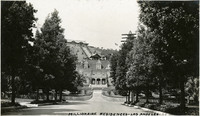 McCarthy Album 04, Photograph 095 Caption: "Millionaire Residences -- Los Angeles.," c. 1915-1916. Shows view from street of the "Magic Castle," a chateau-style residence built in 1909 by Rollin B. Lane. The building is now used as a night club and performance venue for magicians, and houses the Academy of Magical Arts. A mansion built by brothers Adolph and Eugene Bernheimer in 1914 can be seen on a hill above, displaying Asian influences in its architecture.
 -
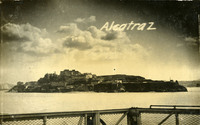 McCarthy Album 05, Photograph 023 Caption: "Alcatraz," c. 1906. View of Alcatraz Island in San Francisco Bay. The building on the highest part of the island, just to the left of center in the photograph, is the Alcatraz Citadel (also known as Fort Alcatraz). Built in 1859 by the U.S. Army for coastal defense purposes, the Citadel began serving as a prison in 1861. It ceased function as a defense fortification and became the Pacific Branch of the U.S. Military Prison in 1907. The Citadel was demolished in 1909. Over the next two decades the facilities on the island were modified and modernized, becoming a federal penitentiary in 1934.
 -
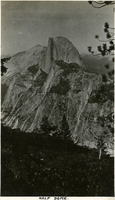 McCarthy Album 09, Photograph 295 Caption: "Half Dome," c. 1917. The iconic granite Half Dome rises above the Yosemite Valley in this photograph, taken from a neighboring peak.
 -
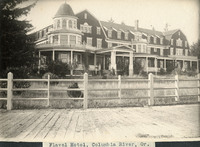 McCarthy Album 08, Photograph 115 Caption: "Flavel Hotel, Columbia River, Or.," c. 1909. Built at the turn of the century, the Flavel Hotel housed passengers waiting to board steamships of the Great Northern Pacific Steamship Company bound for San Francisco and other ports. The Flavel family constructed the hotel as part of an effort to establish the town of Flavel on Tansy Point along the Columbia River. The town failed to attract sufficient residents, however, and was annexed into Warrenton by 1918. By the time this photograph was taken, the hotel appears to have been abandoned.
 -
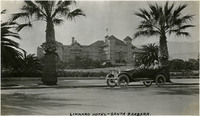 McCarthy Album 04, Photograph 097 *Caption: "Linnard Hotel -- Santa Barbara.," c. 1920. Automobile parked on street before the luxury Hotel Potter. Opened in 1903 by Milo M. Potter, it sold in 1919 to the Santa Barbara Hotel Company, controlled by D.M. Linnard. The famous luxury resort burned down in 1921. See also 96-07-08-alb05-070.
 -
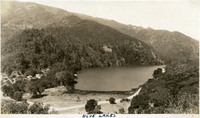 McCarthy Album 04, Photograph 225 Caption: "Blue Lakes," c. 1920. Lake surrounded by wooded mountains.
 -
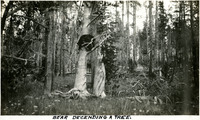 McCarthy Album 09, Photograph 042 Caption: "Bear Decending [sic] a Tree," c. 1923. The bear in 96-07-08-alb09-041 is seen beginning his descent from the tree in this photograph.
 -
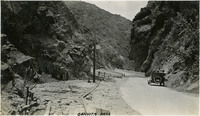 McCarthy Album 04, Photograph 098 Caption: "Gaviota Pass," c. 1915-1916. Shows concrete bridge over Gaviota Creek at Gaviota Pass, a pass in the Santa Ynez mountains just north of Santa Barbara. The pass allows U.S. Route 101 to pass through the coastal mountains to the interior.
 -
 McCarthy Album 04, Photograph 226 Caption: "Hopland-Clear Lake Highway," c. 1925. Birdseye view of the Hopland Grade (also called the Hopland Pass), now part of California State Route 175 connecting Hopland (Mendocino County) with Lakeport on Clear Lake, in Lake County. The road, built in the early 1920s, is sometimes called the "crookedest road in California."
 -
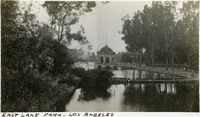 McCarthy Album 05, Photograph 284 Caption: "East Lake [sic] Park, Los Angeles," c. 1906. Eastlake Park in Los Angeles was originally created by the city in 1881 under the name "East Los Angeles Park." Renamed Eastlake Park in 1901, it gained its current name, Lincoln Park, in 1917. This photograph shows the park's elaborate bandstand and portions of the lake for which the park is named.
 -
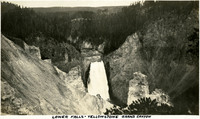 McCarthy Album 09, Photograph 043 Caption: "Lower Falls - Yellowstone Grand Canyon," c. 1923. As the Yellowstone River flows north from Yellowstone Lake it passes over two waterfalls (Upper and Lower Yellowstone Falls) before reaching the Yellowstone Grand Canyon. This photograph shows the 308-foot Lower Yellowstone Falls, as seen from a nearby mountain top or bluff. It carries more water volume than any other waterfall in the Rocky Mountains.
 -
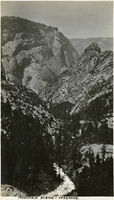 McCarthy Album 09, Photograph 298 Caption: "Mountain Scene - Yosemite," c. 1917. Granite cliffs and evergreen trees dominate this photograph.
 -
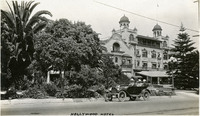 McCarthy Album 04, Photograph 099 Caption: "Hollywood Hotel," c. 1915-1916. Façade of Hotel Hollywood, with automobile parked on street outside. The hotel, originally built in 1902 and expanded in 1905, served as a social venue for many of Hollywood's early film stars. It was torn down in 1956 to make way for an office building.
 -
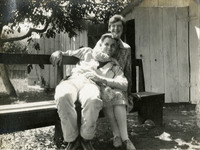 McCarthy Album 04, Photograph 227 No caption, c. 1920. Unidentified man and woman on bench near the Russian River. See also 96-07-08-alb04-228.
 -
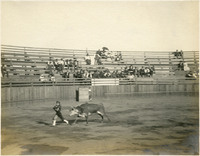 McCarthy Album 08, Photograph 241 No Caption: Photograph shows a female bullfighter dodging a bull in a bullring, in Tijuana, Mexico.
 -
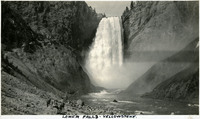 McCarthy Album 09, Photograph 044 Caption: "Lower Falls - Yellowstone," c. 1923. This photograph features the massive Lower Yellowstone Falls, as seen from the falls' base. A group of unidentified people standing to one side provides some sense of scale. As the Yellowstone River flows north from Yellowstone Lake it passes over two waterfalls (Upper and Lower Yellowstone Falls) before reaching the Yellowstone Grand Canyon. The 308-foot Lower Yellowstone Falls carries more water volume than any other waterfall in the Rocky Mountains.
 -
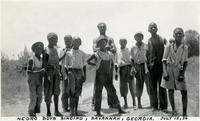 McCarthy Album 11, Photograph 161 Caption: "Negro Boys Singing, Savannah, Georgia. July 15, 34." A group of young boys of various ages pose for a photograph along a country road.