Wong Liu Tsong, professionally known as Anna May Wong (1905-1961)
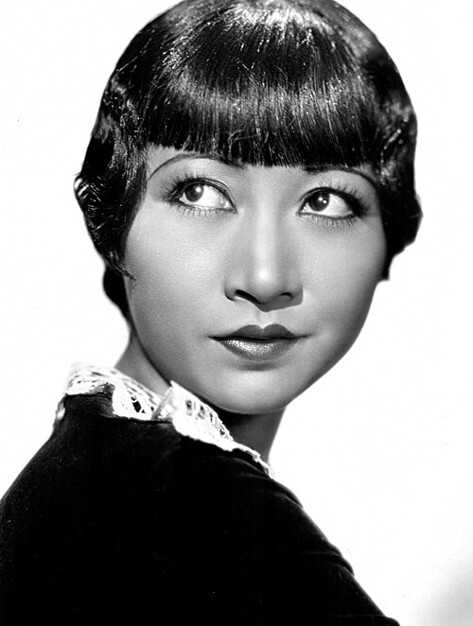
Born Wong Liu Tsong on January 3, 1905, in Los Angeles—just north of Chinatown—Anna May Wong became the first Chinese American film star to achieve international fame. Her birth name, “Liu Tsong,” translates roughly to “willow frost.” She grew up in a multicultural neighborhood alongside Chinese, Irish, German, Japanese, Mexican, and Eastern European families. Her parents were second-generation Chinese Americans, and her grandparents had arrived in the United States in the mid-19th century. Captivated by movies from a young age, Wong decided at just 11 years old that she would become an actress—an extraordinary ambition for a Chinese American girl in early 20th-century America.
She began working as an extra and secured her breakthrough role in The Toll of the Sea (1922), one of the first Technicolor films. She soon appeared in Douglas Fairbanks’ The Thief of Bagdad (1924), becoming a rising star of the silent film era and an international fashion icon. In the 1920s and 1930s, she was celebrated as one of the world’s best-dressed women and embraced the modern “flapper” style. Wong’s career spanned vaudeville, silent film, sound film, radio, stage, and television. In the early sound era, she appeared in films such as Daughter of the Dragon (1931), Shanghai Express (1932) alongside Marlene Dietrich, Java Head (1934), and Daughter of Shanghai (1937). Frustrated by Hollywood’s stereotypical casting of Asian women as villains (“Dragon Ladies”) or submissive figures (“Butterflies”), Wong left for Europe in 1928, where she found greater artistic freedom and starred in acclaimed productions including Piccadilly (1929). One of the most painful moments of her career came in 1935, when Metro-Goldwyn-Mayer refused to cast her as O-Lan in the film adaptation of The Good Earth, instead awarding the role to a white actress in “yellowface.” Despite screen testing, Wong was denied the opportunity to portray a Chinese character in a major Hollywood production—an example of the racial barriers she consistently confronted.
Determined to reconnect with her heritage, Wong toured China in the mid-1930s, visiting her ancestral village and documenting the journey on film. During World War II, she devoted time and personal funds to support China’s resistance against Japanese invasion, placing advocacy above career advancement. In 1951, Wong again broke ground with The Gallery of Madame Liu-Tsong, becoming the first Asian American to star in a U.S. television series. Though many recordings of the show no longer survive, its significance remains profound.
Anna May Wong died in 1961 at age 56. For years, her legacy was overshadowed by the limited roles she was forced to play. Today, she is recognized as a trailblazer who navigated systemic discrimination with grace and determination. As the first Chinese American actress to gain international recognition, she opened doors for generations of Asian American performers and reshaped the possibilities of representation in American media.