Marian Cleeves Diamond (1926-2017)
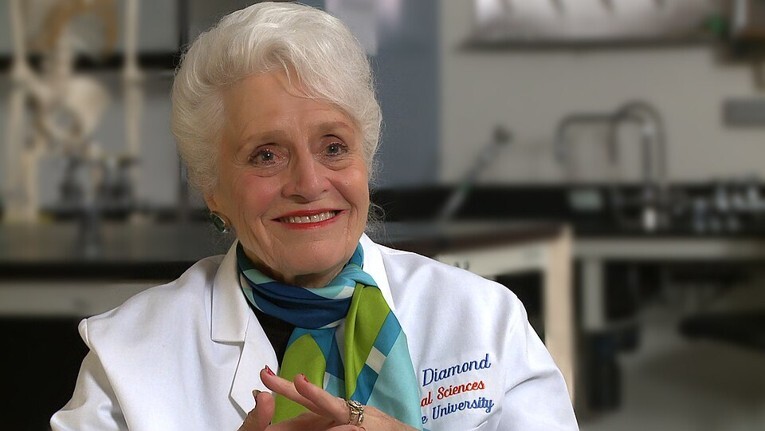
Born in 1926 in Glendale, California, Marian Cleeves Diamond became a pioneering neuroscientist whose research fundamentally reshaped our understanding of the human brain. At a time when scientists largely believed the brain’s structure was fixed after childhood, Diamond helped prove that it could change, grow, and adapt throughout life.
Diamond earned her Ph.D. in anatomy from the University of California, Berkeley, where she would spend most of her career as a beloved professor and researcher. In the 1960s, she and her colleagues conducted groundbreaking experiments demonstrating that enriched environments could physically alter the brain’s cerebral cortex. Their work showed that stimulation, learning, and experience could increase cortical thickness—powerful evidence of what is now known as neuroplasticity. Her findings challenged long-held scientific assumptions and opened new pathways in neuroscience, education, and rehabilitation. Diamond’s research suggested that curiosity, mental engagement, and environment play a profound role in shaping intelligence and brain development.
In 1984, Diamond gained international recognition when she was granted access to study preserved sections of Albert Einstein’s brain. Her analysis identified unusual characteristics in regions associated with mathematical reasoning and spatial thinking, sparking renewed public fascination with the biological basis of genius. Beyond the laboratory, Diamond was an extraordinary educator. Her dynamic lectures at UC Berkeley—often delivered while holding an actual human brain—captivated generations of students. She was among the first professors at the university to receive teaching awards in a field historically dominated by men, and she became a role model for women pursuing careers in science.
Throughout her life, Diamond championed the idea that the brain thrives on stimulation at every age. She advocated for lifelong learning, intellectual curiosity, and enriched environments not only for children, but for older adults as well. Marian Diamond’s legacy endures in modern neuroscience’s embrace of brain plasticity. Through rigorous research, fearless questioning of established beliefs, and passionate teaching, she transformed how the world understands the brain—and empowered generations to believe that growth and learning never stop.