Billie Jean King (1943- )
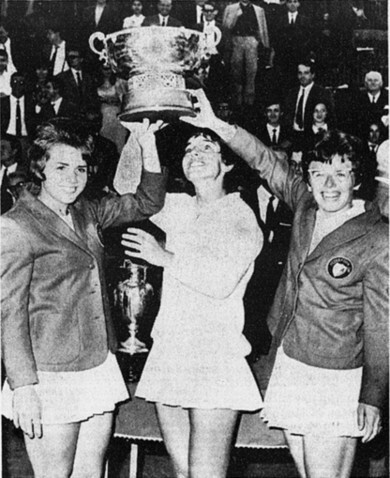
Born Billie Jean King Moffitt in 1943 in Long Beach, California, Billie Jean King grew up in an athletic family and first excelled in softball before turning to tennis as a pre-teen. By age 13, she had already declared her ambition: to become the best tennis player in the world. She attended Long Beach Polytechnic High School and later enrolled at what is now California State University, Los Angeles, leaving in 1964 to pursue professional tennis. (Decades later, she returned with the intention of completing her degree.) From the beginning, King challenged the sport’s traditions. As a teenager, she was barred from a group photograph at a tournament for wearing tennis shorts—sewn by her mother—instead of the customary white dress. Her refusal to conform foreshadowed a career defined by pushing boundaries both on and off the court. King went on to win 39 Grand Slam titles across singles, doubles, and mixed doubles and was ranked the world’s number one female tennis player for five years. She represented the United States in seven Federation Cups (now the Billie Jean King Cup) and nine Wightman Cups. In 1973, at age 29, she defeated 55-year-old Bobby Riggs in the internationally televised “Battle of the Sexes,” a landmark match that symbolized the fight for gender equality in sports.
Yet King’s impact extended far beyond championships. When the Open Era began, she became a leading advocate for equal prize money. In 1972, after winning the U.S. Open and receiving $15,000 less than the men’s champion, she announced she would not return unless pay was equal. In 1973, the U.S. Open became the first major tournament to offer equal prize money to men and women. King helped launch the first professional women’s tennis tour in the early 1970s, backed by sponsor Virginia Slims, and worked tirelessly to unify players behind a single, independent circuit.
In 1973, she became the first president of the Women’s Tennis Association (WTA), giving female players a collective voice. In 1974, she co-founded the Women’s Sports Foundation, expanding opportunities for girls and women in athletics nationwide. She also played a leadership role in World TeamTennis and helped elevate women’s professional sports into the mainstream. Her advocacy came with personal costs. In the early 1970s, King began a same-sex relationship, fearful of the consequences in a deeply homophobic era. In 1981, she became the first prominent professional female athlete to be publicly outed, following a lawsuit. She immediately lost her endorsement deals but refused to deny her identity. Her courage marked a turning point in LGBTQ+ visibility in sports. She later divorced her husband, Larry King, while maintaining an amicable relationship, and began a long-term partnership with fellow professional tennis player Ilana Kloss.
Over her lifetime, King has received numerous honors recognizing both her athletic excellence and her transformative advocacy: induction into the International Tennis Hall of Fame (1987) and the National Women’s Hall of Fame (1990); designation as one of Time magazine’s People of the Year (1975); the Presidential Medal of Freedom; the renaming of the Federation Cup to the Billie Jean King Cup in 2020; and the Congressional Gold Medal in 2024. Billie Jean King’s legacy is not only one of championship titles, but of systemic change. Through resilience, strategic leadership, and personal bravery, she reshaped professional tennis, expanded opportunities for women in sports, and helped redefine equality on and off the court.