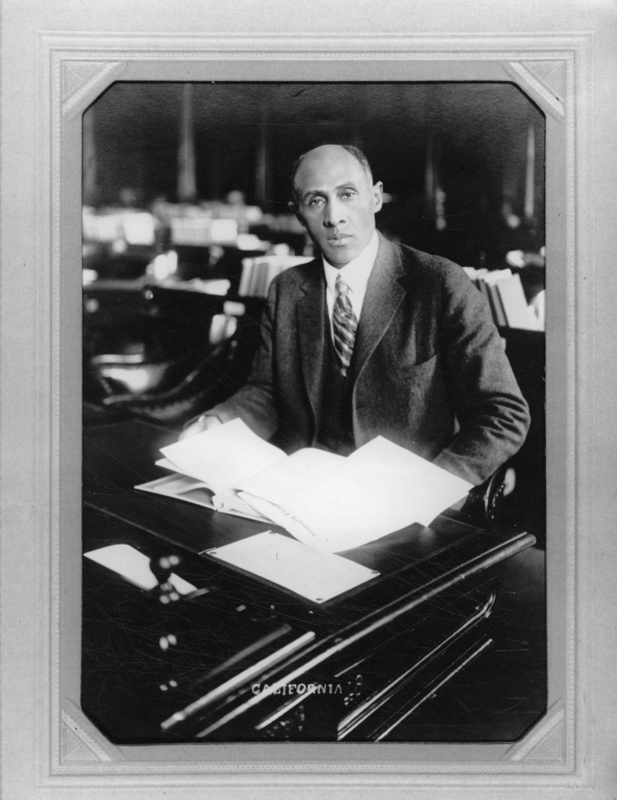
Frederick Madison Roberts (1879-1952)
Early Life
Frederick Madison Roberts was the great grandson of President Thomas Jefferson and Sally Hemings, an enslaved woman at Jefferson’s Monticello estate. Their son, Madison Hemings, was freed in 1827, a year after his father’s death, and moved from Virginia to Ohio. Frederick’s parents met and married in Chillicothe, Ohio, then known as an abolitionist hub, and moved the family to Los Angeles when Frederick was a young boy. Frederick’s father, Andrew Jackson Roberts, taught public school and owned several businesses in the community, establishing the first Black owned mortuary in Los Angeles, which Frederick would help run after graduating from college in Colorado. Frederick was the first African American student to graduate from Los Angeles High School and attended the University of Southern California, Colorado College, and the Barnes-Worsham school for mortuary science. After college, he would establish his own newspaper for African American readers, called The New Age Dispatch. Roberts was heavily involved in civil rights activism as an active member of both the National Urban League and the National Association for the Advancement of Colored People (NAACP). Frederick married Pearl Hines Roberts, who was a renowned choral director and the first African American woman pipe organist in Northern California.
Political Career
Roberts became the first known African American politician in California when he was elected to the California State Assembly in 1918. Although his district was predominantly white, Roberts’s family name and businesses were already well-established in the African American community in Los Angeles at the time that he ran, helping him win much of the Black vote in his district and tipping the scale in his favor to secure his seat. One of his opponents took on a racially discriminatory stance while running against him, using racial slurs in his campaign speeches against Roberts. Despite his vicious opposition, Frederick won the election, making history and paving the way for demographic change in the legislature. Eager to make a difference the moment he stepped into office, Roberts introduced 17 bills during his first month in the legislature.
During his tenure, Roberts advocated for public schools, prohibition, better sanitation, and civil rights legislation. He authored the bill that created the University of California at Los Angeles known as Assembly Bill (AB) 626 in 1919, as well as AB 693 the same year, which banned preventing the use of public space based on a person’s race, religion, or color. In 1921, Roberts’s AB 452 became law, which prohibited publishing offensive images of People of Color in educational texts. After 16 years in the State Assembly, Frederick lost his reelection bid in 1934 to Augustus F. Hawkins.
Shortly before his death, Roberts was selected to receive an ambassadorship from President Dwight D. Eisenhower. Tragically, Roberts lost his life soon after the announcement in a fatal car crash outside of his home in 1952.